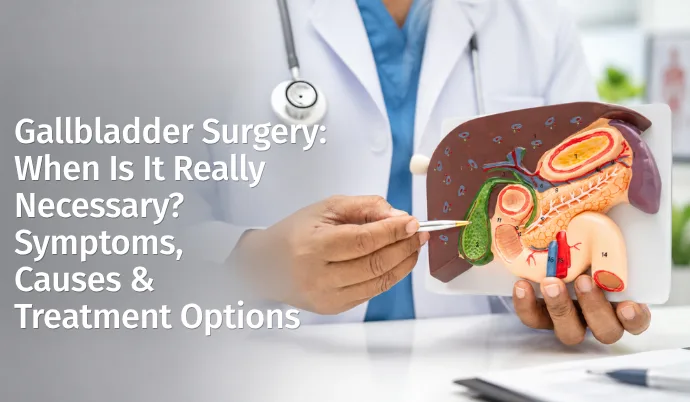
The gallbladder is a small, pear-shaped organ tucked just beneath your liver on the upper right side of your abdomen. Its primary job is to store and concentrate bile—a fluid produced by the liver that helps digest fats.
While the gallbladder plays a helpful role in digestion, it is not essential for survival. When stones or inflammation develop, this small organ can become a source of intense pain and severe health complications. In fact, gallbladder disease is one of the most common surgical conditions across the country, a 2026 BMJ Public Health review by Mohite et al., estimated that about 32 lakh cholecystectomies were performed in India in 2022 alone. Deciding whether you need gallbladder surgery requires understanding your symptoms, knowing the causes of gallbladder disease, and exploring modern, minimally invasive treatment approaches.
Here is a clinical guide on when surgery becomes necessary, how stones form, and what to expect from modern treatment.
Key Takeaways: Quick Summary
- Gallstones Are Prevalent Yet Not Generally Harmful: Silent gallstones are mostly not treated through surgery.
- Indications for Medical Attention: Continuous or significant discomfort in the upper right abdominal area, particularly following greasy meals, signifies gallbladder issues.
- Best Type of Treatment: Laparoscopic surgery is the best method for removing a malfunctioning gallbladder.
- The Body after the Gallbladder Has Been Removed: The body adjusts quickly since the liver makes bile to be released into the small intestine.
What Causes Gallbladder Problems?
Gallbladder troubles originate from an imbalance of the composition of bile. The common causes of gallbladder problems are the following:
- Formation of Gallstones (Cholelithiasis): Bile is made of cholesterol, bilirubin, and salts. If bile has too high a concentration of cholesterol or bilirubin, it will solidify into small stones.
- Gallbladder Infection (Cholecystitis): When gallstones block the cystic duct (the duct that brings bile), the bile accumulates and leads to inflammation and infection.
- Biliary Dyskinesia: This is a functional condition that occurs when the gallbladder does not contract, which creates pain without stone formation.
- Gallbladder Polyps or Sludge: Sludge or polyps can block the flow of bile and create discomfort.
Symptoms of Gallbladder Problems You Should not ignore
People do not experience symptoms with all gallstones. However, once a stone blocks the bile duct, the person experiences biliary colic. Here are some of the most frequent signs:
- Sudden, Severe Abdominal Pain: Severe pain in the center or upper right part of the stomach that can last from half an hour to many hours.
- Pain in Other Areas: The pain might also be felt in the right shoulder or between the shoulder blades.
- Nausea and Vomiting: The person may feel nauseated or have an upset stomach after the consumption of fatty food.
- Jaundice: The people may experience yellowing of both the skin and the eyes together with dark urine (indicating the blockage of the main bile duct).
- Fever and Chills: If a person has body temperature increase together with abdominal pain, it might indicate acute inflammation or infection and a need for quick medical help.
When Is Gallbladder Surgery Really Necessary?
A common question patients ask is: "Can't I just take medication for gallbladder stone treatment?"
While certain oral medications can dissolve cholesterol stones, they are rarely effective for large or calcified stones, take months or years to work, and carry a high rate of stone recurrence once medication stops.
Surgical removal of the gallbladder (known medically as a cholecystectomy) is generally recommended in the following scenarios:
- Symptomatic Gallstones: You have frequent, painful attacks involving your gallbladder.
- Acute Cholecystitis: A very intense infection or inflammation affecting the gallbladder wall.
- Pancreatitis Due to Gallstones: A stone could go down through and block the pancreatic duct.
- Large Polyps: Gallbladder polyps of over 10 mm can be dangerous and need to be removed.
- "Porcelain" Gallbladder: Presence of significant calcium deposition in the gallbladder wall is associated with increased chances of gallbladder cancer.
Modern Treatment Options: Laparoscopic vs. Open Surgery
If your specialist determines that surgery is required, modern medical technology makes the process safe and straightforward.
1. Laparoscopic Gallbladder Surgery (Gold Standard)
This is the most common and minimally invasive approach:
- Process of Operation: The expert doctor creates three to four small cuts on the abdomen, each being less than one inch in size. The small camera (laparoscope) along with certain surgical tools are put into the abdomen to take out the gallbladder.
- Advantages: Less pain after the operation, limited scars formed on the surface of the body, smaller duration of hospital stay (it can take only one night) and the speedy restoration of physical activities after some time after the operation.
2. Open Cholecystectomy
In complicated situations such as major scarring from previous operations, constant widespread infections or bleeding abnormalities, the surgeon can proceed with an open surgical approach through a single substantial incision below the ribs. Recovery usually continues for 4 to 6 weeks.
How Sir Ganga Ram Hospital (SGRH) Can Help
For an effective treatment of complicated biliary diseases, correct selection of the surgical team as well as the clinical organization is of utmost importance. Sir Ganga Ram Hospital's Department of Minimal Access Metabolic and Bariatric Surgery and the Department of Gastroenterology offer the best available experience as well as state-of-the-art surgical facilities for the treatment of gallbladder diseases.
Why Patients Trust SGRH for Gallbladder Care:
- Innovative Laparoscopy Knowledge: SGRH has achieved recognition for its innovation in minimal invasive surgery techniques throughout India with respect to its accuracy and safety.
- Advanced Diagnosis Capabilities: An advanced state-of –the-art diagnostic facility that includes High Resolution Ultrasound, MRCP (Magnetic Resonance Cholangiopancreatography), and Endoscopic Ultrasound (EUS) with the ability to detect complicated stones, obstructions in the duct, or any signs of inflammation.
- Emergency ERCP Services: Providing ERCP service at all hours in case stones fall in common bile duct or cases striking acute pancreatitis.
- Interdisciplinary Medical Approach: Cooperation between senior surgeons operating in gastrointestinal tract and clinical dietitians and other specialists ensures smooth surgical processes from the initial stage till the post-operational period.
Life After Gallbladder Removal: What Changes?
Your liver keeps making bile, so you are capable of digesting food normally without a gallbladder. Therefore, bile goes straight to the small intestine without being stored.
- Initial Changes: For the last few weeks after surgery, stick to foods rich in fiber and low in fat, as this may help you avoid any temporary loose stools or digestive problems.
- Continued Quality of Life: Most patients have pain-free lives again in several weeks after surgery and come back to their normal diets without any restrictions..
Conclusion
Overlooking symptoms of the gallbladder can cause serious problems such as severe infection, jaundice, or pancreatitis. If you have recurrent pain in the abdomen or any misgiving about your digestion, visit a specialist as soon as possible to ensure a safe treatment plan for gallstones. Make a contact with the specialists in minimally invasive surgery and gastroenterology at Sir Ganga Ram Hospital today.
Book an appointment with SGRH today.
FAQs
Q1: Will I be able to live normally if I do not have a gallbladder?
Yes. The gallbladder merely stores bile and is not essential for living. There will be no impact on your health after recovery, as your liver will keep producing bile.
Q2: Are there treatments of gallstones other than surgery?
Treatments of gallstones without surgery, such as medical dissolution therapy or ultrasonography, are seldom applied nowadays. They may be employed in case one cannot undergo surgical treatment because of serious health issues. However, it should be noted that stones tend to reappear soon after stopping the treatment.
Q3: How soon will I be back to work after laparoscopic gallbladder removal?
Usually, a patient can return to work and light daily activities after 7–10 days. Heavy activities should be avoided for 2–4 weeks.
Q4: Do gallstones come back after gall bladder removal?
Once gallbladder removal is completed, gallstones cannot form there anymore. However, there are rare cases of gallstones being formed in the common bile duct but these cases are treated with the help of endoscopic procedures, not through surgical intervention.
Q5: Which dietary practices should I adhere to right after the procedure?
In the first 2-3 weeks after the operation, it is highly recommended to consume small and frequent meals with low amounts of fat and spices. When your body gets used to the constant flow of bile, you can include healthy fats in your meals.
Q6: What could happen if I don’t pay attention to my gallstone symptoms?
The consequences of ignoring the symptoms of gallstones can be fatal, leading to conditions like acute gallbladder inflammation (cholecystitis), blockage of bile ducts and jaundice development, bile duct infection (cholangitis), as well as severe inflammation of pancreas (gallstone pancreatitis).
Q7: How long is the procedure of laparoscopic cholecystectomy in general?
The process itself lasts for 45-90 minutes. Most of the patients are watched for a couple of hours and then either released that same day or the following one.
Book an appointment with SGRH today.