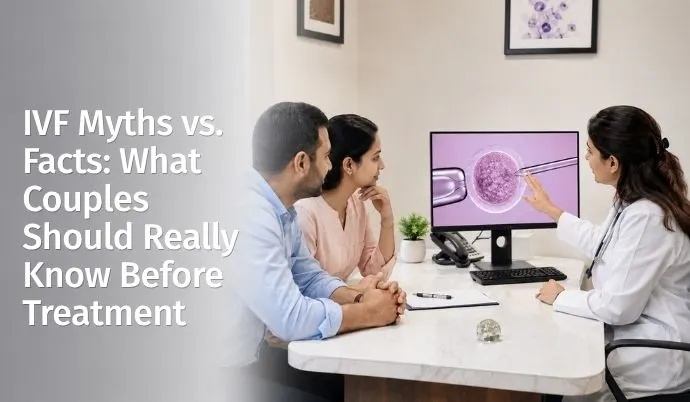
For millions of couples navigating the delicate path toward parenthood, the realization that natural conception isn't occurring can evoke a profound mix of grief, frustration, and uncertainty. In India, infertility is no longer a silent, isolated struggle; data indicates that approximately 10% to 15% of couples across the country face reproductive challenges. Globally, the World Health Organization estimates that 1 in 6 people will experience infertility in their lifetime, establishing it as a major public health priority.
The sheer volume of people using reproductive technology and its growth have not reduced the negative perceptions about IVF. In fact, many people still view IVF through a lens of social stigma, outdated cultural taboos, misleading advertising and medically inaccurate information. When couples come to a clinic, they often carry the baggage of inaccurate advice given to them by friends and family, alarming online discussions, and/or the misperception that ART provides an immediate, foolproof solution.
The path to using artificial reproduction methods should be based upon removing sensationalized language from the discussion of these methods and establishing realistic expectations through clinical science. Working with a quality IVF Center in Delhi will provide couples with the clarity and accuracy of evidence-based medical treatment that is customized to each individual's physiology.
Understanding the true medical facts behind reproductive science reduces anxiety, prevents financial missteps, and empowers couples to participate actively in their care plan.
The clinical reality: There are no promises of absolute guarantees with any ethical reproductive specialist or laboratory. While assisted reproductive technologies (ART) have dramatically changed how clinicians practice medicine today, they are subject to many complex biological factors. These factors include: maternal age; quality of oocytes (eggs); DNA integrity of sperm; chromosome abnormality of embryos; and the ability of the uterus to accept implantation. For women under 35 years old, their first cycle live birth rate is usually about 45-55 percent.
The Reality of Clinical Practice: Historically, there was an cultural burden associated with childlessness in India, which primarily fell upon women. In terms of science, this is totally incorrect. According to diagnostic information, female factors represent approximately 30-40 percent of all cases of childlessness; male factors represent approximately 30-40 percent; both female and male factors together represent approximately 15 percent; and the remaining cases fall into the category of "unexplained infertility."
The clinical truth is; there are large-scale long-term global studies on millions of children who were born using ART. These studies indicate that the children born through ART will be just as healthy, have normal development, and have the same intellectual capabilities as children who were conceived naturally. There is no increased risk for congenital anomalies among the children born through ART compared to the general population.
The Reality of Clinical Practice: There's no need to take time off from your everyday life once you've had an embryo transferred. In fact, taking too much time away from your regular routine will increase the amount of stress you're under mentally, as well as decrease the amount of blood that can circulate throughout your lower body (pelvis)..
The reality is that many people are intimidated by the prospect of taking a daily hormone injection for approximately two weeks. Modern methods of delivering these medications use a pen-like injector with small needles that have been specifically developed to deliver medication subcutaneously (under the skin) to either the abdominal area or the upper thigh. Most individuals will experience a brief, slight pinch rather than intense pain when using these devices.
In terms of "clinical reality", women are born with millions of immature eggs. Each month during her normal menstrual cycle, a woman's body selects a group of eggs for development, but only one of these eggs will become fully developed and be released from the ovary through ovulation. The other undeveloped eggs will die off and disappear from the woman's ovaries.
A successful fertility treatment program relies on a precisely timed, multi-stage medical workflow. Here is what couples can expect during each phase of their treatment at a specialized IVF Centre in Delhi:
Before issuing any hormone medication, reproductive specialists conduct an exhaustive baseline evaluation. For women, this includes assessing ovarian reserve via Anti-Müllerian Hormone (AMH) blood tests, baseline antral follicle counts (AFC) via transvaginal ultrasound, thyroid function, prolactin levels, and pelvic imaging. For men, a comprehensive semen analysis evaluates sperm count, motility, morphology, and, when indicated, sperm DNA fragmentation index (DFI).
To maximize the chances of creating viable embryos, injectable gonadotropin hormones are administered to stimulate the ovaries to grow multiple follicles simultaneously. Throughout this 10-to-12-day window, the patient visits the clinic periodically for transvaginal ultrasounds and blood hormone monitoring to track follicular growth and adjust medication dosages safely. Once the leading follicles reach optimal maturity (typically 18–20 mm), a precisely timed "trigger shot" (hCG or GnRH agonist) is administered to finalize egg maturation.
Exactly 34 to 36 hours after the trigger shot, the egg retrieval procedure is performed. Conducted under total intravenous anaesthesia, the reproductive specialist uses an ultrasound-guided needle inserted vaginally to gently aspirate follicular fluid from the ovaries. The procedure takes approximately 15 to 20 minutes, is entirely painless, and requires no surgical incisions. Simultaneously, the male partner provides a fresh semen sample, which undergoes laboratory washing and density gradient centrifugation to isolate the most motile, morphologically sound sperm.
Once retrieved, the eggs are immediately evaluated by embryologists to confirm maturity. Fertilization is then executed using one of two primary laboratory techniques:
Fertilized eggs (zygotes) are placed inside triple-gas incubators that precisely mimic the natural physiological environment of the human fallopian tube and uterus. Over the next 3 to 5 days, embryologists monitor cellular division. Advancing embryos to the Blastocyst Stage (Day 5 or Day 6) allows the clinical team to select the most structurally robust embryos with the highest implantation potential, significantly reducing the risk of early pregnancy loss.
Embryo transfer is a quick, gentle outpatient procedure that requires no anesthesia or sedation. Guided by real-time abdominal ultrasound, the specialist threads a thin, soft catheter through the cervix and places the chosen embryo gently into the optimal location within the uterine cavity. Any remaining high-grade embryos are frozen via Vitrification (ultra-rapid flash freezing) for future use.
Following the transfer, daily progesterone supplementation is prescribed to prepare and support the uterine lining for embryo implantation. Approximately 10 to 14 days post-transfer, a quantitative Serum Beta-hCG blood test is performed to confirm pregnancy.
Age remains the single most influential biological factor determining female fertility and IVF outcomes when using one's own eggs. Women are born with a finite pool of eggs that naturally declines in both quantity and genetic quality over time.
As a woman ages, the cellular machinery within her eggs becomes more prone to errors during meiotic division. This leads to a higher proportion of aneuploid embryos (embryos with missing or extra chromosomes). Aneuploid embryos typically fail to implant or result in early miscarriages.
For women in higher age brackets or those with a history of recurrent pregnancy loss, advanced medical technologies such as Pre-implantation Genetic Testing for Aneuploidies (PGT-A) allow embryologists to screen biopsies from blastocysts for chromosomal normality before transfer. Selecting only euploid (chromosomally normal) embryos significantly increases implantation rates and shortens the time to achieve a healthy pregnancy.
For decades, male fertility was evaluated solely through basic manual semen parameters (concentration, motility, and shape). However, routine semen analysis only provides a surface-level assessment. Modern reproductive medicine recognizes that sperm health is far more complex:
While medical technology does the heavy lifting in the laboratory, optimizing your overall health prior to starting an IVF cycle improves biological readiness and supports optimal outcomes.
Sleep hygiene and stress management are two of the most important things you can do to improve your overall health.
Chronic stress results in release of cortisol and adrenaline, which can interfere with the subtle communication that occurs between the brain and ovaries for reproduction. Ensure you get 7-8 hours of restful sleep every evening; add some form of gentle exercise (such as yoga or walking) to your daily schedule; and seek out a qualified fertility counselor to assist you in dealing with any emotional distress associated with your treatment.
Navigating assisted reproduction demands an established, highly accredited tertiary medical center that combines advanced embryological science with compassionate, ethical patient care.
The department of IVF and human reproduction at Sir Ganga Ram Hospital (SGRH) in New Delhi stands as a landmark of clinical excellence in reproductive endocrinology:
Embarking on IVF Treatment is a courageous, transformative step toward building your family. By dispelling common myths, recognizing the biological realities of fertility, and addressing health proactively, couples can navigate their treatment journey with clarity and confidence.
If you are exploring fertility options or seeking an expert opinion, schedule a comprehensive consultation with the reproductive specialists at Sir Ganga Ram Hospital today.
Book your appointment with SGRH today.
For women who are less than 35 years old and have had unprotected sex regularly for 12 months, and still haven't gotten pregnant, it is time to see a specialist. If you're 35 years old or older, and you've tried getting pregnant for at least six months, it's also time to schedule an appointment with a specialist. If your periods are unpredictable, if you have endometriosis (or have previously), or if you've had previous pelvic surgeries, then you need to go to a specialist right away.
A full standard cycle lasts about four to six weeks. During this time, we will perform your first baseline ultrasound check, inject you with 10 to 12 days of fertility drugs (stimulation), collect your eggs, fertilize them in the lab, allow the embryos to grow, and then place the developed embryos back into your uterus (embryo transfer).
There are no set rules as to how many times you may try to get pregnant using fertility treatments; however, many doctors will suggest that you review your treatment plan if you have had three unsuccessful attempts. If you are unsuccessful after several attempts to achieve a pregnancy through fertility treatments, then re-evaluating your diagnosis, performing genetic testing (PGT-A), or looking into obtaining an egg/sperm donor may give you a new direction to proceed.
No, in India, sex selection has been made illegal through the use of the Pre-Conception and Pre-Natal Diagnostic Techniques (PCPNDT) Act. Genetic testing, such as PGT, is strictly used for screening against serious inherited genetic conditions or chromosomal abnormalities that may affect the health of a baby during pregnancy.
As a group, women who suffer from Polycystic Ovary Syndrome (PCOS) generally achieve great outcomes with IVF. This is primarily due to the fact that many of these women also tend to have a large number of remaining eggs (ovarian reserve).
Yes. A diagnosis of obstructive or non-obstructive azoospermia does not automatically rule out biological fatherhood. Advanced surgical sperm retrieval techniques—such as Micro-TESE (Microscopic Testicular Sperm Extraction), TESA, or PESA—allow urologists to extract viable sperm directly from testicular tissue, which can then be used to fertilize eggs via ICSI.