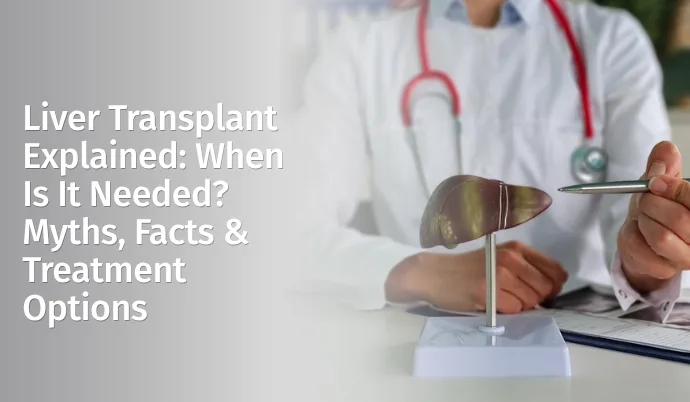
The liver is one of the body's most remarkable organs, performing over 500 vital functions including filtering toxins, digesting fats, regulating blood clotting, and storing energy. Because of its incredible resilience, the liver can often continue functioning even when damaged. However, when chronic disease or acute failure severely compromises its ability to work, a liver transplant becomes the only definitive, life-saving option. According to the NIH, India performs roughly 4,500 liver transplants each year, making it one of the largest programs for this surgery in the world.
Facing the difficulties of end-stage liver disease can be challenging due to the many misconceptions about organ donation and surgery. Knowing when a transplant is required, debunking some of the myths, and learning where to find the quality surgical care necessary allows patients and their families to make good health decisions.
This guide provides useful information about liver transplantation, clearing up some common misconceptions, and investigating possible modern treatment options.
Key Takeaways: Quick Summary
- Ultimate Treatment: A liver transplant is the most effective treatment for late-stage liver disease (cirrhosis) and acute liver failure when all other treatments have failed.
- Living or Deceased Donor: A transplant can be carried out with only a portion of a liver taken from the body of a healthy live donor or a whole liver taken from a dead (brain-dead) donor.
- Quick Regeneration: A slice of a portion of liver transplanted will regenerate completely in the body of the donor and the recipient within a few weeks.
- Specialized Treatment: Successful liver transplants require a special liver transplant hospital with the necessary experience and expertise.
When Is a Liver Transplant Needed?
A liver transplant is considered when a person's liver is damaged beyond its ability to repair itself or function adequately. Doctors evaluate candidates using standardized clinical tools like the MELD (Model for End-Stage Liver Disease) score to determine urgency.
Common Conditions Requiring Transplantation:
- End-stage liver cirrhosis: This condition corresponds to the complex scarring of the liver due to chronic diseases such as Hepatitis B and C, excessive alcohol use, and Metabolic Dysfunction-Associated Steatohepatitis.
- Acute liver failure: This condition is marked by severe liver dysfunction occurring rapidly over the course of days or weeks. It may be due to liver damage caused by drug overdose, acute or chronic hepatitis, or autoimmune disease.
- Liver cancer (Hepatocellular carcinoma): A limited group of candidates with localized liver tumors that match specified criteria may be eligible for liver transplant.
- Biliary diseases: Progressing conditions, e.g., Primary Biliary Cholangitis (PBC) or Primary Sclerosing Cholangitis (PSC) result in bile duct obstruction, so that liver disease develops.
- Genetic and metabolic disorders: Diseases such as Wilson’s disease, Hemochromatosis, or Alpha-1 Antitripsin deficiency result in toxic buildup in the liver.
Common Myths About Liver Transplants
Misinformation often prevents patients from seeking timely evaluation for liver transplant surgery in Delhi. Let’s separate myth from fact:
Myth 1: A living liver donor loses a permanent part of their liver.
- Fact: Clearly, the liver stands alone as the only organ in the body that can totally regenerate itself. When a living donor decides to give part of his/her liver (typically about 50-60%), both the remaining part of the donor's liver and the transplanted sections of liver will come back to near normal size in 6-8 weeks.
Myth 2: Liver transplants are only for people who drank too much alcohol.
- Fact: Statistics have shown that while liver disease caused by alcohol consumption is one reason for liver transplant surgeries, other reasons such as liver disease caused by non-alcoholic fatty liver disease (MASH), chronic viral hepatitis, genetic disorders, autoimmune diseases, and liver tumors are also common causes of liver transplant surgeries.
Myth 3: Older adults cannot undergo a liver transplant.
- Fact: Age cannot be presumed as the only obstacle to organ transplants. It is the individual's overall physical condition and cardiac performance that will determine if they are eligible for the procedure, not their age.
Myth 4: You cannot live a normal, active life after a liver transplant.
- Fact: Most transplant patients recover well and resume their lives as before—going back to work, taking trips, playing sports, and sometimes even having children.
Treatment Options and Surgical Pathways for Liver Transplant
When evaluating a liver transplant, patients generally undergo one of two main surgical procedures:
1. Living Donor Liver Transplantation (LDLT)
LDLT refers to the situation when an individual of one's family (legal phrase "near relative" per the Indian law) donates a part of his liver. The fact that the procedure can be planned beforehand makes it possible to shorten the waiting period and avoid the health decline of the person who is waiting on the waiting list for the deceased donor.
2. Deceased Donor Liver Transplantation (DDLT)
This term refers to a situation when the full liver is obtained from the person who is brain-stem dead. The donor of the liver is in the ICU, and the donor's organ is transplanted into a patient who is in the National Organ Transplant Organization (NOTTO) or State Organ Transplant Organization (SOTTO) waiting list.
Legal Aspects and Procedure for Liver Transplantation in India
All liver transplant operations have to comply with the provisions of the Transplantation of Human Organs and Tissues Act (THOTA) of 1994 (and subsequent amendments) in order to protect patient safety, avoid the business of selling organs, and ensure transparency.
1. Mandatory Legal Categorization of Living Donors
Under Indian law, living donors are classified into two distinct legal categories:
- Close Relatives: Partners, mother and father, offspring, brothers and sisters, forefathers, and descendants. Legal documents like proof of birth, documents of marriage, government-issued ID cards (Aadhaar/Passport), and the mandatory DNA testing process are used as evidence of its relationship.
- Distant Relatives (Voluntary Donors): People who wish to donate with genuine intentions must pass rigorous background checks to ensure that financial transfers or coercive or commercial transactions were not involved.
2. The Authorization Committee Clearance
Every instance of living donor organ transplant, particularly when related to the people in question donating organs, must be brought before an independent committee for approval.
- Evaluation Interview: The committee performs interviews with the parties involved via video to ensure that the donation was made voluntarily and did not involve any third-party organizations.
- Psychiatric and Medical Check-ups: Donors undergo psychiatric evaluations to confirm their mental health.
- Strict Timelines and Transparency: The committee must carry out its investigations quickly and make its decisions known to the public without revealing anyone's identity.
3. Deceased Donor Allocation (NOTTO Framework)
Allocation of livers from deceased donors is directed through the National Organ and Tissue Transplant Organization (NOTTO) in case of patients with no immediate living donor, thanks to the concession of Brain Stem Death established by law, which is certified by a medical board. The allocation process takes place according to blood matching criteria, geographical location, and MELD scores.
4. Prohibition of Commercial Trading
Trading human organs for money, or acting in-between for any financial compensation is regarded as a grave crime under THOTA, punishable by substantial monetary fines and imprisonment.
The Step-by-Step Transplant Process
[1. Clinical Evaluation] ➔ [2. Donor Matching & Approvals] ➔ [3. Transplant Surgery] ➔ [4. ICU Recovery & Aftercare]
- Pre-Transplant Assessment: There are different tests such as blood tests and heart-lung tests, along with imaging (MRI CTA) and psychological tests for the recipient and donor.
- Legal and Ethical Clearance: When it comes to brain death organ donations, the relevant documents are sent to the Authorisation Committee to ensure compliance to the Transplantation of Human Organs Act (THOA).
- The Surgery Procedure: A complex surgery that lasts for 8 to 12 hours and takes place in two operating rooms by specialized surgeons.
- Post-Operative Recovery: Post-operative care is provided in a specialized transplant ICU to monitor liver function and prevent infection and to finely tune the anti-rejection (immunosuppressive) medication that has been provided.
World-Class Liver Transplant Care at Sir Ganga Ram Hospital (SGRH)
Choosing the right facility is vital for successful transplant outcomes. As a premier liver transplant hospital in Delhi, department of Live transplant at Sir Ganga Ram Hospital (SGRH) offers end-to-end hepatobiliary and transplant care.
Why SGRH is a Trusted Choice for Liver Transplantation:
- Leading the Way in Transplant Knowledge: SGRH is home to a highly skilled team of surgeons, hepatologists, and anesthesiologists with deep understanding and expertise in various liver transplant procedures.
- State-of-the-art Equipment & Facilities: Fully equipped with technologically advanced Operating Theatres, 3T imaging suites, dedicated pathology laboratories, and Transplant ICUs.
- Unique Patient Care Solution: An effective network of hepatologists, surgeons, critical care specialists, and clinical dietitians ensures the best care for the patient.
- Legal Counseling at the Highest Level: SGRH represents the interests of the family in THOTA compliance and Authorization Committee.
Conclusion
A liver transplant is a remarkable, life-saving medical advancement that offers patients with severe liver failure a second chance at a healthy, fulfilling life. By understanding the true facts, identifying symptoms early, and choosing an established facility for liver transplant surgery in Delhi, families can navigate this treatment journey with confidence and clarity.
Connect with the liver transplant specialists and hepatologists at Sir Ganga Ram Hospital to schedule an expert evaluation today.
Book an appointment with SGRH today.
FAQs
1. How long does a living donor take to recover after liver donation surgery?
The usual stay of a liver donor in a hospital is 7-10 days after the operation. After 2-3 weeks, the donor can do light household activities, and after a period of 4-6 weeks, he/she will be able to go to work due to the good regenerative ability of the liver.
2. What is the success rate of liver transplant surgery in Delhi?
Leading hospitals like Sir Ganga Ram Hospital, equipped with modern sophisticated techniques, ICUs, and well-structured immunosuppressive protocols, offer a success rate of over 90% regarding survival of the patient after a year from the operation, which gives great prospects for the patients.
3. How long do I need to take anti-rejection medications after a transplant?
The patients who underwent transplantation need to take immunosuppressive drugs for a lifetime. The immune system will see the newly-transplanted liver as a foreign organism and begin attacking it if they stop taking all medicines. The dosage will be adjusted gradually until the lowest effective dose.
4. Can a liver transplant cure liver cancer completely?
Yes. For patients with early-stage, localized liver cancer (Hepatocellular Carcinoma) that meets specific medical criteria, a liver transplant removes both the tumor and the diseased liver tissue, offering the best chance for a complete cure
5. What lifestyle changes are required after receiving a liver transplant?
After getting a liver transplant, the patients must eat a suitable diet, engage in regular workouts, adhere faithfully to the course of medication as prescribed by the doctor, maintain cleanliness in order to prevent any form of infection, remain abstinent from alcohol and visit the doctor for checkups on a regular basis.
6. What is the MELD score, and how is it used?
The MELD score is a scoring system used to measure a person's end-stage liver disease based on some laboratory results including bilirubin, sodium, INR, and creatinine. The score indicates the seriousness of the liver illness and also has the function of prioritizing patients on the deceased donor list.
7. How do I know if my family member is eligible to be a living liver donor?
A living donor has to be older than 18 years of age and younger than 55 years of age, should have a matching blood group, must be in the best of health, and should function normally in terms of liver functioning and needs to satisfy legal "near relative" qualification under the Indian law of transplantation.