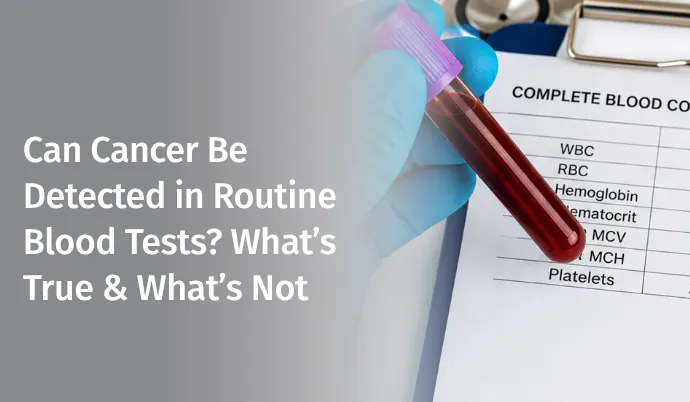
Every year, millions of people get their annual physicals, glance at their perfectly normal Complete Blood Count (CBC) results, and breathe a sigh of relief, thinking, "Great, I don't have cancer." The desire for a single, simple blood test that can screen the entire body for any sign of a tumor is universal. It sounds like the ultimate medical safety net.
But does this medical magic bullet actually exist? The question is more urgent than ever. According to data from the Indian Council of Medical Research (ICMR), there are approximately 2.5 million people living with cancer in India, with over 7 lakh new cancer patients registered and 5,56,400 cancer-related deaths occurring every year.
Faced with these sobering statistics, relying on a basic, routine lab panel to give you a clean bill of oncological health is a dangerous misconception. The short answer to whether blood tests can detect cancer is both yes and no. To protect yourself and understand your lab results properly, we need to separate medical facts from hopeful myths. Here is the clinical truth regarding early cancer detection tests, the reality of tumor markers, and what your blood work actually tells us.
Key Takeaways: Quick Summary
Can blood tests detect cancer during a routine checkup?
No, a standard routine blood test, like a Complete Blood Count (CBC) or a Comprehensive Metabolic Panel (CMP)—cannot definitively detect or diagnose solid tumors like breast, lung, or colon cancer.
When you get a general health checkup, the doctor is testing the functional levels of your organs. They are looking at cholesterol, blood sugar, kidney filtration, and liver enzymes. These tests are not designed to look for cancer cells.
However, routine tests can act as an early warning system by showing suspicious "red flags" that prompt a doctor to look deeper. For example:
What is a specific blood test for cancer detection (Tumor Markers)?
A tumor marker test is a specific blood test for cancer detection that looks for proteins or chemicals produced either by cancer cells themselves or by the body in response to cancer.
Unlike a routine CBC, doctors must specifically order these tests. However, they are not perfect. High levels do not guarantee you have cancer, and normal levels do not guarantee you are cancer-free. This is why doctors generally use them to monitor patients already diagnosed with cancer to see if their treatment is working, rather than screening the general public.
Common tumor markers include:
Are there new early cancer detection tests available?
Yes, the future of oncology is shifting toward "Liquid Biopsies"—advanced early cancer detection tests that look for microscopic fragments of DNA shed by tumors directly into the bloodstream.
Cancer cells grow and die rapidly. When they die, they release tiny pieces of their unique genetic code (Circulating Tumor DNA or ctDNA) into your blood. Revolutionary new tests (like the Galleri test) are being developed to detect these microscopic DNA fragments, potentially screening for over 50 types of cancer through a single blood draw.
While liquid biopsies are an incredible medical breakthrough, they are currently quite expensive, still undergoing rigorous clinical trials, and are mostly recommended for high-risk individuals with a strong family history of cancer, rather than the general public.
If a blood test isn't enough, how is cancer actually diagnosed?
Because a blood test for cancer detection only provides clues, doctors must rely on more definitive methods to give a final diagnosis. If your blood work shows red flags, your doctor will order:
Precision Oncology at Sir Ganga Ram Hospital (SGRH)
Navigating the fear of cancer and understanding complex lab reports can be incredibly overwhelming. You do not have to interpret the numbers alone.
At Sir Ganga Ram Hospital (SGRH), our Department of Medical Oncology and Preventive Health and Wellness teams work hand-in-hand. We believe in proactive, evidence-based screening. If you have a family history of cancer or are experiencing unexplained symptoms like profound fatigue or sudden weight loss, our specialists will design a targeted screening protocol. Using state-of-the-art diagnostic labs and advanced imaging, we ensure that you receive the exact tests you need—eliminating unnecessary anxiety while maximizing the chances of early, life-saving detection.
Do not rely on guesswork or Google to interpret your health. Book an expert oncology screening consultation at SGRH today.
Frequently Asked Questions (FAQs)
Q1: Does a completely normal routine blood test mean I am 100% cancer-free?
A: No, a normal routine blood test does not rule out cancer. Many early-stage solid tumors (like early breast or lung cancer) do not bleed, alter organ function, or change your blood chemistry enough to be detected on a standard CBC or metabolic panel.
Q2: Why doesn't my doctor test all my tumor markers "just in case" during my annual checkup?
A: Testing all tumor markers causes more harm than good due to "false positives." Many non-cancerous conditions (like infections or inflammation) can cause tumor markers to elevate. Testing a healthy person often leads to massive anxiety, expensive full-body scans, and invasive biopsies, only to find out there was no cancer at all.
Q3: Can blood tests detect leukemia and lymphoma early?
A: Yes, blood cancers are the exception. Because leukemia directly affects the bone marrow where blood is made, a simple Complete Blood Count (CBC) will often show severe, unmistakable abnormalities in the number and shape of white blood cells, allowing for rapid detection.
Q4: Are there specific early cancer detection tests I should be doing every year?
A: Yes, but they are not all blood tests. Evidence-based early detection relies on physical screenings: annual mammograms for breast cancer (for women over 40), regular Pap smears for cervical cancer, colonoscopies for colon cancer (starting at age 45-50), and low-dose CT scans for heavy smokers to check for lung cancer.