For generations, treating complex internal medical conditions meant undergoing open, invasive surgery. Patients routinely accepted large incisions, general anesthesia, significant blood loss, and weeks or months of painful hospital recovery as the necessary price for a cure. Today, Interventional Radiology is taking place in modern medicine, one that allows doctors to treat deep internal diseases through a pinhole puncture no larger than a standard needle. This medical specialty is known as Interventional Radiology (IR).
Often described as the "surgery of the 21st century," Interventional Radiology eliminates the need for scalpel blades and major operating theaters for a massive array of illnesses. By using advanced, real-time medical imaging, interventional radiologists can look inside your body and precisely navigate micro-catheters and wires directly to the source of a problem.
If you or a loved one are facing a surgical recommendation, understanding the power of minimally invasive image-guided therapies is essential. Here is a comprehensive guide to how Interventional Radiology works, its clinical benefits, and 10 serious medical conditions that can now be completely treated without traditional surgery.
Key Takeaways: Quick Summary
What Is Interventional Radiology?
Interventional Radiology (IR) is an advanced subspecialty of radiology that uses minimally invasive, image-guided procedures to diagnose and treat diseases in nearly every organ system. While traditional radiology focuses on diagnosing illnesses using scans, an interventional radiologist uses those same scans to actively treat conditions inside the body.
How Does Interventional Radiology Actually Work?
To understand Interventional Radiology, imagine navigating a complex city map using a high-definition GPS system.
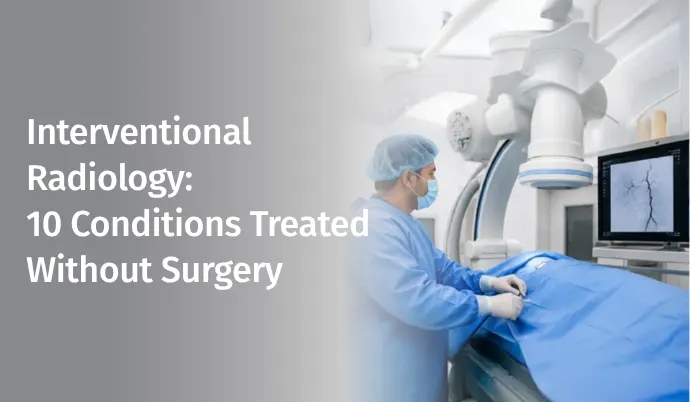
Instead of cutting open the body to expose an organ, an interventional radiologist makes a tiny 2-millimeter nick in the skin, usually in the groin or the wrist to access a major blood vessel. They then insert a microscopic, flexible tube called a catheter into the vessel.
Using real-time, high-definition imaging systems like fluoroscopy (moving X-rays), ultrasound, or CT scans, the physician monitors the catheter's journey as it glides seamlessly through the body's natural highway of blood vessels. Once the catheter reaches the diseased organ or blockage, the doctor can deploy targeted tools such as microscopic beads, tiny metallic coils, balloons, stents, or medication to treat the condition from the inside out.
10 Conditions Interventional Radiology Treats Without Surgery
1. Thyroid Nodules
Thyroid nodules are solid or fluid filled lumps that form within the thyroid gland. While most are non cancerous large nodules can cause visible swelling in the neck, difficulty swallowing, a choking sensation or voice changes. Traditional management often involved surgically removing part or all of the thyroid gland, requiring lifelong hormone replacement medication
2. Liver Tumors: Open surgery is often impossible if liver tumors are too large, close to major blood vessels, or if the patient suffers from advanced cirrhosis. Instead, interventional radiologists treat the cancer non-surgically through a pinhole using three precise techniques:
3. Enlarged Prostate (Benign Prostatic Hyperplasia - BPH)
An enlarged prostate, or Benign Prostatic Hyperplasia (BPH), is a non-cancerous growth of the prostate gland that compresses the urethra. This causes severe urinary symptoms in men, including a weak urine stream, frequent nighttime urination, difficulty starting urination, and a persistent feeling of an incomplete empty bladder.
4. Blocked Arteries (Peripheral Artery Disease)
Atherosclerosis causes plaque to build up inside the arteries of the legs or heart, severely restricting blood flow. This leads to intense pain while walking (claudication), non-healing skin ulcers, and in severe cases, gangrene and amputation.
5. Varicose Veins
Varicose veins are enlarged, twisted, and painful veins that occur when the internal valves of the leg veins fail, allowing blood to pool backward. Left untreated, they cause heavy legs, chronic skin discoloration, swelling, and painful ulcers.
6. Kidney Bleeding
Severe kidney bleeding can happen suddenly due to physical trauma, industrial accidents, kidney biopsies, or underlying renal tumors. This is a critical medical emergency that can rapidly lead to hemorrhagic shock.
7. Spinal Pain (Nerve Compression)
Chronic, debilitating back pain caused by herniated discs, spinal stenosis, or arthritis can make daily life unbearable. When physical therapy fails, patients often dread major spinal fusion surgeries.
8. Deep Vein Thrombosis (DVT)
DVT occurs when a large blood clot forms deep inside the veins of the leg or pelvis. If a piece of this clot breaks free, it can travel straight to the lungs, causing a life-threatening emergency called a Pulmonary Embolism.
9. Bile Duct Obstruction
The bile duct carries vital digestive fluids from the liver and gallbladder to the intestines. Gallstones or tumors can block this duct, causing bile to back up into the bloodstream, leading to severe jaundice, liver failure, and life-threatening infections.
10. Port Placements for Chemotherapy
Cancer patients undergoing long-term chemotherapy require frequent, painful intravenous access. Repeatedly puncturing arm veins causes the vessels to collapse, become scarred, and cause severe discomfort.
Why Interventional Radiology is Changing Modern Healthcare
The profound benefits of Interventional Radiology over open surgery are fundamentally reshaping patient expectations and clinical outcomes:
Advanced Minimally Invasive Care at Sir Ganga Ram Hospital (SGRH)
Minimally invasive medicine requires a combination of highly sophisticated imaging systems and extreme clinical precision. Because interventional radiologists work through a tiny pinpoint, there is no margin for error.
At the Department of Interventional Radiology at Sir Ganga Ram Hospital (SGRH), we house one of the most advanced, fully integrated image-guided therapy centers in the region. Our board-certified, fellowship-trained interventional radiologists utilize state-of-the-art flat-panel digital subtraction angiography (DSA), dedicated high-resolution ultrasounds, and intra-procedural 3D CT imaging to perform highly complex vascular and non-vascular interventions daily.
Working in close, multidisciplinary coordination with our oncology, neurology, vascular surgery, and gastroenterology departments, SGRH ensures that you receive a highly customized, safe, and effective treatment plan tailored specifically to your diagnosis. Before opting for major, open surgery, explore whether a minimally invasive alternative is right for you. Schedule an expert consultation with our Interventional Radiology team at SGRH today.
FAQs
Q1: Will I have a scar after an Interventional Radiology procedure?
A: No, you will not have a noticeable scar. Because the instruments used are microscopic, the skin entry point is only about 2 millimeters wide. It requires no surgical stitches or staples to close. Once healed, the puncture site is usually completely invisible or resembles a tiny, faded freckle.
Q2: Is Interventional Radiology considered a safe alternative for elderly or high-risk patients?
A: Yes, in many cases, it is the only safe option. Elderly patients or those suffering from multiple chronic conditions (like advanced heart disease, severe diabetes, or kidney failure) are often deemed "unfit for surgery" due to the high risks of general anesthesia and major blood loss.
Q3: How long do I need to stay in the hospital after an IR procedure?
A: It depends on the specific condition being treated, but many procedures (like varicose vein ablation, port placements, and nerve blocks) are performed on a day-care basis, meaning you go home the same day.