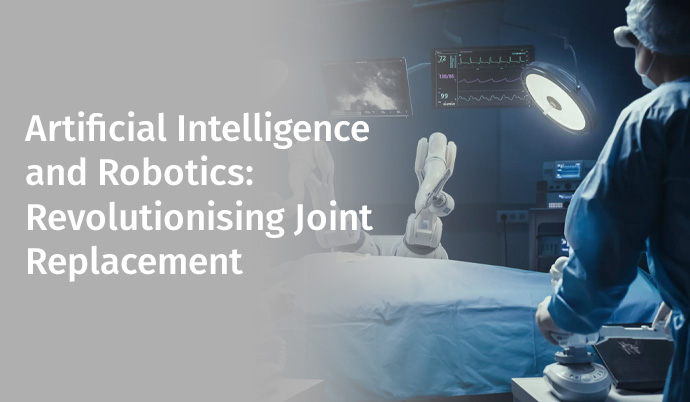
Picture a future in which a major surgical procedure is transformed from an event of fear to a customisation, predictable procedure that leads to miraculous recovery times. This future is not some far-off vision but rather is occurring today inside the operating theatres of our best hospitals in Delhi. For the thousands of Delhiites suffering from crippling arthritis and joint pain, two powerful technologies are rewriting the journey toward a pain-free life, namely, Artificial Intelligence (AI) and Robotics.
For decades, joint replacement surgery, while extremely effective, often relied heavily on the individual skill, experience, and guesswork of the surgeon. Patients would have to hope for the best, carefully entrusting the skilled hands of the surgeon to determine if their new knee or hip was properly aligned. Now, that trust is being supported by data, precision, and predictive ability that once might have been dismissed as science fiction.
The Dynamic Duo: Al is the Brain, Robotics is the Hand
A common misconception is that Al and Robotics are the same thing. In reality, they are a brilliant team, each with a distinct role.
● Artificial Intelligence with Augmented Reality (AI/AR) is the Master Strategist and Executor.
Think of AI/AR as the supremely intelligent navigator for your surgical procedure. Before a single knife is used, the surgeon utilizes AI software to analyze your specific CT or MRI scan. This software does not simply provide a 3D image of your joint; rather it performs virtual surgery. The software then informs the surgeon of the exact size of the implant needed for the surgery, the optimal location to insert your implant based on an analysis of your unique anatomy, and further predicts complications such as risk of leg length discrepancy or risk of implant instability. It does this by drawing on data from a massive database from thousands and thousands of previous surgeries. This is the ultimate in the utilization of personalized medicine.
The next evolution is already here: Augmented Reality (AR) Ask yourself: Imagine a surgeon wearing AR glasses projecting the surgical plan- like a GPS for the anatomy- right onto the patient's anatomy (i.e. body) rather than requiring a large robotic console. This takes precision guidance to the next level of accessibility without interrupting the Surgeon's workflow.
● Robotic Assisted Surgery(RAS) is the Precision Artist.
If Al is the architect who creates the ideal blueprint, then the robot can be considered an automated craftsman that executes the blueprint with perfect accuracy. In the surgical process, the surgeon has complete control over a robotic arm. This arm is autonomous and functions as a smart tool that gives haptic feedback; it will resist when you move beyond the safe,
pre-defined plan of care that Al gave you. The result is that the bone is cut with sub-millimeter accuracy while maximizing healthy bone and soft tissue preservation, which leads to an implant that is uniquely fitted to you.
Why Should This Matter to You? The Patient-Centric Benefits
This technological synergy isn't just for show; it translates into tangible, life-changing benefits for patients right here in our community.
Addressing Common Concerns: Cost, Trust, and the Human Touch
It is natural to have questions about this new paradigm
The Indian Context: A Leapfrog Moment in Healthcare
India, and Delhi in particular, are in a unique position to leapfrog conventional surgical approaches. In our lives, we have incorporated digital technology in every aspect, so why should it be any different in healthcare?
Patients are more educated and have greater expectations today; they do not want just a surgery but want the best surgery possible with the least disruption to their lives. While introducing AI/AR and Robotics into medical centres like ours puts Delhi on the globe as a medical tourism destination, more importantly, it also introduces world-class care to our citizens.
Our leadership in advanced joint replacement is part of a larger institutional commitment to this new, data-driven standard of patient care.
Conclusion
AI/AR and Robotics are not competing technologies but complementary forces revolutionizing Arthroplasty. Both Al/AR and Robotics enhances cognitive planning, precision and predictive capabilities and better outcomes. Their integration creates a seamless, data-driven workflow that improves surgical outcomes, reduces complications, and personalizes patient care. Though challenges like costs and training remain, the synergistic potential of AI/AR and robotics promises to define the future of Orthopaedic surgery, making Joint Replacement safer, more efficient, and more accessible than ever before.
The narrative is not about AR versus robotics, but rather about how these technologies will converge to create the next standard of care in arthroplasty.
In the future, robotic systems that utilize AI and AR will be commonplace - where the surgeon plans and visualizes the procedure through an AR headset, then can effortlessly control a robotic arm to carry out the plan in a shared immersive environment. This would allow the surgical team to incorporate the enhanced visualization capabilities of AR and the precision of robotics into a hybrid approach that would ultimately allow for personalized planning, real-time visualization, and excellent luck during the procedure to maximize outcomes for hip and knee arthroplasty patients.
For anyone in Delhi who is considering a joint replacement, it cannot be overstated that - the age of not knowing is over. The future will be personalized, precise, and predictable. It will be a future where technology and human ability will work hand in hand to restore not just your joint, but your life, and you are comfortable and dignified. The revolution is inherently quiet, but the distinction it will make in patients' lives will be profound and resonant throughout our city.