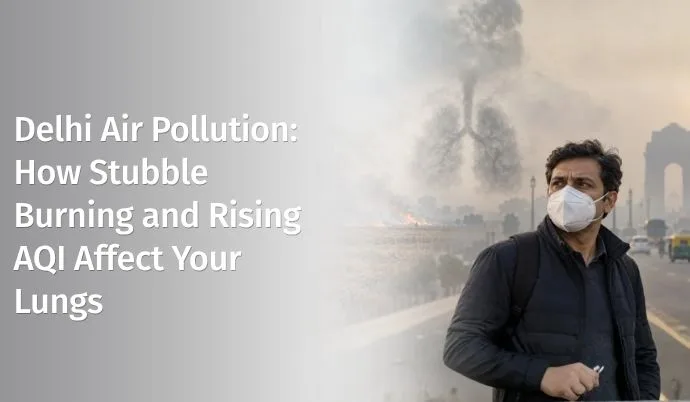
Every autumn, as the monsoon retreats and the weather turns cool, the National Capital Region (NCR) faces a recurring respiratory emergency. The sky turns hazy, a thick smog envelopes the city, and breathlessness becomes a common complaint across households.
Delhi experiences a recurring annual air pollution crisis, typically peaking between October and February where the Air Quality Index (AQI) frequently crosses 400 to 500+ into the "Hazardous" category.
The crisis of Delhi air pollution is a complex environmental challenge driven by a mix of seasonal weather changes, vehicular emissions, industrial dust, and agricultural burn-off. Understanding how stubble burning effects combine with rising toxic levels helps us evaluate the true AQI impact on lungs and take proactive steps for respiratory defense.
The sharp decline in air quality each October and November is driven by a combination of atmospheric dynamics and human activity:
In summer, warm air easily ascends, allowing pollutants at the ground level to be dispersed in the atmosphere. In late fall, cool air settles to the surface beneath the warm air mass, creating thermal inversion. This results in the formation of a "blanket" of warm air that prohibits pollutants such as smoke, dust, and fumes from getting mixed in the atmosphere.
Farmers in nearby agricultural regions are using fire to remove leftover stubbles to prepare the fields for planting winter wheat. The northwestern winds are then carrying large amount of smoke—composed of carbon monoxide, volatile organic compounds (VOCs), and high density particles—into the basin area of the Delhi region.
Stubble burning thus has a cumulative impact that causes localized air pollution problems to transform into serious smog problems on the regional level that may last for weeks.
The Air Quality Index (AQI) translates complex chemical pollutant measurements into a single, easy-to-understand color-coded scale:
| AQI Category | Numerical Range | Health Impact on Human Lungs |
|---|---|---|
| Good / Satisfactory | 0 – 100 | Minimal impact; clean air for outdoor activities. |
| Moderate | 101 – 200 | May cause minor breathing discomfort in sensitive individuals. |
| Poor / Very Poor | 201 – 400 | Triggers acute respiratory symptoms, coughing, and throat irritation. |
| Severe / Hazardous | 401 – 500+ | Poses serious health risks to healthy individuals; severe impact on chronic patients. |
In terms of AQI, the most dangerous particles for the lungs are those that are smaller than 2.5 micrometers in size (PM2.5):
While systemic solutions require policy-level changes, individual action significantly reduces toxic exposure. Here is a guide on how to protect lungs from pollution during severe AQI spikes:
Knowing how to protect lungs from pollution equips families to safeguard their health during severe winter smog episodes.
Managing severe respiratory stress caused by high Delhi air pollution requires timely medical intervention and expert clinical guidance. Sir Ganga Ram Hospital provides a comprehensive clinical network to safeguard lung health during toxic smog episodes:
The yearly rise in Delhi air pollution is a major issue impacting respiratory problems but taking measures in advance can reduce its harmful effects. Whether it is about the harmful impact caused by the burning of stubble or the AQI impact on lungs, keeping family members safe during pollution involves knowing some crucial measures which can help them be healthy during smog months.
If there is constant trouble with coughing, wheezing or difficulty in breathing, then don’t hesitate in seeking help. The Department of Pulmonology and Department of Paediatrics at Sir Ganga Ram Hospital can provide you with the best medical assistance.
For more information visit www.sgrh.com.
The rise in pollution in the air quality of Delhi is observed every year in the autumn period due to many reasons. One is the low rate of wind blows and lower temperatures, which helps to keep the emissions close to the surface of the Earth (thermal inversions). Second reason is the burning of agricultural residues in the nearby states, letting the clouds of smoke into the air currents coming to that region from the northwest.
Major consequences of stubble burning originate from high levels of fine particles (PM2.5), carbon monoxide, and hazardous organic substances in the smoke. Breathing in this smoke worsens chronic asthma and causes bronchitis in adults, reduces lung capacity in children, and increases the risk of cardiovascular disease.
At levels of air quality index (AQI) surpassing 400 or 500, an entire day's exposure to outdoor air will correspond to the person having smoked about 15 to 20 cigarettes in terms of particulate matter (PM2.5) exposure, resulting in tissue inflammation due to the oxidative stress from the air polluted throughout the respiratory tract.
In order to keep your lungs healthy, put on a tight-fitting N95 mask when outside, refrain from exercising outdoors in the morning, utilize a HEPA air purifier in your bedroom, perform steam inhalation each day, drink enough water and eat foods that are high in antioxidants.
No. Standard masks and cloths are made in such a way that small PM2.5 and PM10 particles can pass through easily. Only special covered N95, FFP2 or KN95 respirators are capable of catching small dust particles.
At-risk populations include infants and children whose lungs are still developing, the elderly, pregnant women, and people who have pre-existing conditions such as asthma, COPD, bronchitis, and cardiovascular diseases.
Running an air purifier continuously in enclosed living areas or bedrooms during "Very Poor" or "Severe" AQI days maintains a safe indoor breathing zone, allowing your respiratory system to clear accumulated particulate matter and reduce inflammation while you rest.