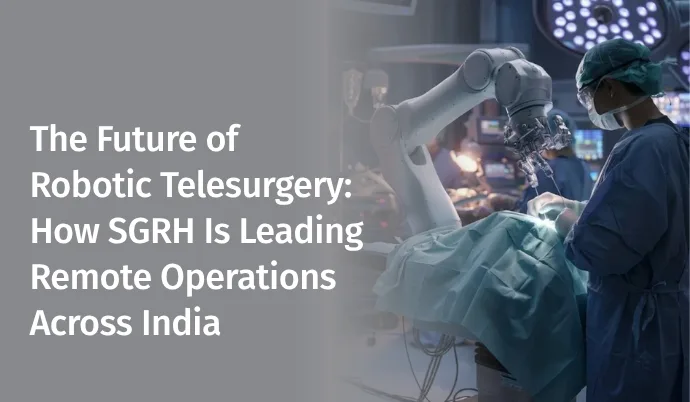
Imagine a world where a patient requires a highly complex, life-saving procedure, but the only specialist capable of performing it is sitting 1,200 kilometers away. A decade ago, this scenario meant a risky, expensive, and agonizingly long medical transfer. Today, it is the exact problem that Sir Ganga Ram Hospital (SGRH) has solved through the revolutionary science of telesurgery.
In a landmark achievement for Indian healthcare in February 2026, the surgical team at SGRH successfully completed a series of complex robotic telesurgery procedures across a staggering distance of 1,200 kilometers. Utilizing ultra-low-latency internet and state-of-the-art robotics, surgeons located in Vapi, Gujarat, seamlessly operated on patients admitted at the New Delhi facility.
This monumental success is transitioning remote healthcare from science fiction into clinical reality. Understanding how these highly precise machines operate is the first step in realizing how they are set to democratize access to world-class surgical care for every citizen, regardless of their zip code.
Key Takeaways: Quick Summary
What is robotic telesurgery?
Robotic telesurgery is a surgical procedure where the operating doctor and the patient are not in the same physical room. The surgeon sits at a digital console and manipulates robotic arms that perform the surgery on the patient at a distant location, connected by ultra-fast internet.
To understand telesurgery, you must first understand standard robotic surgery. In a typical robotic operating room, the surgeon does not stand over the patient with a scalpel. Instead, they sit just a few feet away at a computerized console. They look through a high-definition, 3D monitor and use highly sensitive finger and foot controls to manipulate the robotic arms positioned over the patient.
Telesurgery takes this exact same setup and simply lengthens the "wire." By utilizing incredibly fast, secure communication networks with virtually zero lag, the console can be placed in one state (like Gujarat), while the robotic arms and the patient are located in a surgical hub in another (like Delhi).
How does modern robotic surgery technology work?
The technology uses robotic arms to hold miniature surgical tools and a high-definition 3D camera. A computer instantly translates the surgeon's remote hand movements into scaled-down, microscopic motions inside the patient's body.
The mechanical brilliance of robotic surgery technology lies in its ability to enhance human capability beyond its natural limits. During the recent 1,200 km surgeries, the SGRH team utilized the advanced Mizzo Endo 4000 robotic surgical system. Here is how the machinery operates:
Why is remote robotic surgery crucial for India?
India faces a massive geographical disparity in medical expertise. Remote robotic surgery allows top-tier surgeons located in major metropolitan hubs to perform complex, life-saving surgeries on patients in rural areas without the need for critical patient transport.
India has a highly concentrated medical ecosystem. Most superspecialists are in large metro cities, and most people don’t live there.
When a patient living far from the metropolitan area has a complicated medical emergency, before he or she can even start receiving care in the hospital, the golden hour of treatment is missed while he’s being transported to metro hospital. Remote robotic surgery fills this gap. It enables a local medical team to prep the patient and dock the robotic arms in place, as a superspecialist hundreds of miles away takes control of the console to do delicate tissue work. This saves crucial time, reduces the financial burden of travel, and extends the benefits of robotic surgery—like smaller incisions, faster recovery, and reduced blood loss—to underserved regions.
How SGRH is pioneering India's robotic future
Sir Ganga Ram Hospital established the Institute of Robotic Surgery in 2012 and recently made national history by completing four remote surgeries across 1,200 km in a single 24-hour period.
At Sir Ganga Ram Hospital, we understand that leading the future of telesurgery requires an absolute mastery of the technology today. The Institute of Robotic Surgery (IRS) at SGRH is a dedicated center of excellence pushing the boundaries of minimally invasive care.
Experience the Highest Standard of Surgical Precision
Whether you require a complex gastrointestinal procedure or a delicate urological surgery, you deserve the safest, most advanced technology available.
Contact the Department of Robotic Surgery at Sir Ganga Ram Hospital today to learn how our minimally invasive robotic procedures can help you recover faster and stronger.
Frequently Asked Questions (FAQs)
Q1: Is the robot doing the surgery itself?
A: No. This is a very common misconception. The machine is utterly unable to choose or act independently. It is only an advanced machine that executes flawlessly the same movements performed by a human surgeon at the console.
Q2: Regarding robotic surgery, is it safer than open surgery?
A: Yes, in most cases. Since it utilizes very small incisions, robotic surgery usually causes much less blood loss, less chance of infection, far less post-surgical pain and greatly expediting recuperation time when compared to conventional open surgery.
Q3: Is it true that anyone can do robotic surgery?
Q: Do robotic surgery skills transfer to traditional surgery or vice versa? It involves hundreds of hours of specialized training and mastery in simulators, and that’s why institutions such as the IRS at SGRH emphasize rigorous surgical education.