Lab Result

Your OTP (One time password) received you your registered mobile number.
For Reg. No. & OPD/IPD/EM No., please refer to the respective Bill Receipt.

Request a Callback

Myths About Robotic Surgery: Does the Robot Actually Perform the Operation
  • Home
  • All Blog
  • Myths About Robotic Surgery: Does the Robot Actually Perform the Operation

Myths About Robotic Surgery: Does the Robot Actually Perform the Operation

SGRH 25 Feb 2026

Is a Machine Going to Cut Me Open?"

Robotic surgery is not just the future; it is the present reality in Indian healthcare. The surgical robotics market in India is projected to reach approximately $1.2 billion by 2030, growing at a compound annual growth rate (CAGR) of 17.4%.

Clearly, hospitals and surgeons are adopting this technology at a rapid pace. Yet, despite this massive growth, many patients still have significant doubts. When they hear the term "Robotic Surgery," their minds often jump to science fiction—imagining a completely automated machine performing surgery while the doctor drinks coffee in the next room.

Here we are to clear those misconceptions.

This blog is here to debunk these myths, get robotic surgery explained, and show you why this technology is often the safest option for complex surgeries.

Key Takeaways

  • The "Auto-Pilot" Myth: The robot never makes a single move on its own. It is 100% controlled by the surgeon at all times.
  • The "Video Game" Reality: The surgeon sits at a console controlling the instruments, which mimic their hand movements with microscopic precision.
  • The Precision Advantage: Robotic arms eliminate natural hand tremors and can rotate 360 degrees, reaching areas human hands cannot.
  • The Recovery Bonus: Smaller incisions mean significantly less pain, less blood loss, and a faster return to normal life.
  • SGRH Legacy: From complex cancer removals to 1,200 km remote "telesurgeries," SGRH is a pioneer in multi-specialty robotic procedures.

Does the robot actually perform the surgery on its own?

No, the robot cannot think or act independently; every single movement is 100% controlled by the surgeon in real-time.

The most common myth is that the robot is on "auto-pilot."

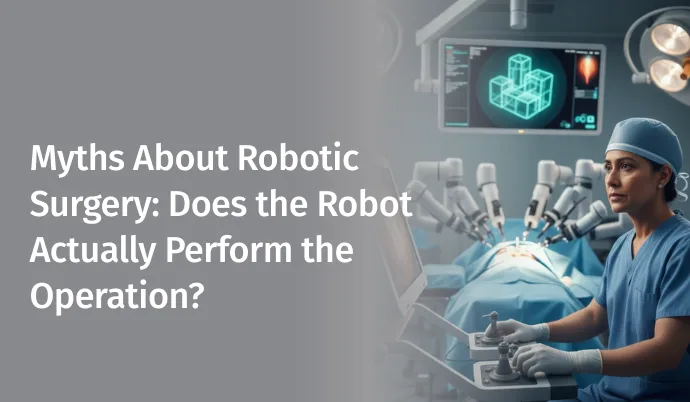
  • The Reality: The robotic system is a "master-slave" setup. The surgeon sits at a console a few feet away from the patient. When the surgeon moves their hand an inch, the robot moves the instrument inside the patient an inch (or even less, if scaled down for microscopic precision).
  • The Control: If the surgeon stops moving their hands, the robot freezes instantly. It makes absolutely zero medical decisions.

So, how exactly does robotic surgery work?

The surgeon controls miniaturized instruments inside the patient while viewing a high-definition, 3D magnified image of the surgical site.

Think of it as shrinking the surgeon's hands and putting them inside the body.

  • The Console: The surgeon looks into a viewer that provides a 3D, high-definition (4K) view of the anatomy, magnified up to 10 times.
  • The Arms: The robot has multiple arms. One holds the high-res camera, and the others hold tiny instruments (scissors, graspers).
  • The Wrist: Unlike traditional laparoscopic (keyhole) instruments which are rigid, straight sticks, robotic instruments have "wrists" that can bend and rotate 360 degrees—far beyond the physical capabilities of a human hand.

What kinds of robotic surgeries are there, and where are they performed?

Robotic systems are used across multiple medical specialties. At Sir Ganga Ram Hospital (SGRH), we offer advanced robotic interventions for nearly every major organ system.

SGRH utilizes state-of-the-art platforms (like the Medtronic Hugo RAS system) to perform complex surgeries across various departments:

  • Urology & Uro-Oncology: Highly precise prostatectomies (prostate cancer), kidney tumor removals, and bladder surgeries that protect delicate pelvic nerves to preserve continence and sexual function.
  • Joint Replacement (Orthopaedics): Robotic-assisted knee and hip replacements that calculate exact implant sizing and perfect ligament balance, allowing patients to walk within 24–48 hours.
  • Gastrointestinal & Colorectal Surgery: Advanced treatments for colon and rectal cancers, complex abdominal wall hernias, and weight-loss (bariatric) surgeries.
  • Gynaecology: Minimally invasive hysterectomies, removal of complex endometriosis, and fertility-preserving surgeries for large uterine fibroids.
  • Groundbreaking Telesurgery: Showcasing our capability, SGRH surgeons recently successfully performed remote robotic "telesurgeries" on patients located over 1,200 km away in Gujarat, proving that advanced technology can bridge the gap of geographic distance.

Why would I choose a robot over a human surgeon?

You aren't choosing a robot over a human; you are choosing a human empowered by a robot to be more precise.

The benefits of robotic surgery are all about enhancing human capability.

  • Tremor Filtration: Even the steadiest expert surgeon has microscopic hand tremors. The computer system filters these out completely, making incisions perfectly smooth.
  • Access to Tight Spaces: The robotic arms can reach deep, narrow anatomical spaces (like the deep pelvis) that are notoriously difficult to access with human hands without making a massive incision.
  • Depth Perception: Standard laparoscopic surgery provides a flat 2D view (like watching TV). Robotic surgery provides true 3D depth perception, crucial for navigating around vital blood vessels.

Is robotic surgery safer than traditional open surgery?

Generally, yes. Because it is minimally invasive, it leads to significantly less blood loss, less trauma, and a lower risk of infection.

  • Smaller Incisions: Rather than making one large, 6-inch cut, the operation is performed through small incisions (ports) about the size of a buttonhole. This keeps internal organs far less exposed to outside air.
  • Less Trauma: The advanced precision is less traumatic on the body, actively preserving surrounding healthy tissues, nerves, and blood vessels that might be damaged during traditional open surgery.

Will I recover faster with robotic surgery?

Yes, most patients experience significantly less pain and leave the hospital days earlier than they would with open surgery.

Because there is no large incision to heal:

  • Pain: Patients need significantly less pain medication (like opioids) after surgery.
  • Hospital Stay: In many complicated cancer operations, patients can be sent home in 2 to 3 days rather than a week or more.
  • Back to Living: You are back at work and able to resume daily activities, like driving, much sooner.

What happens if the robot breaks down during surgery?

The system is built with fail-safes, and the surgeon can instantly convert to traditional methods if absolutely necessary.

This is a common fear, but it is extremely rare.

  • Redundancy: The system performs millions of safety checks per second. If it detects even a tiny anomaly, it locks in place safely.
  • The Backup: The surgeon and their medical staff are right there in the room with the patient. If a highly unlikely technical failure occurred, they can undock the robot in seconds and seamlessly finish the surgery laparoscopically or openly.

Technology in Human Hands

Robotic surgery is not about replacing the surgeon; it’s about enhancing the surgeon. It is an expert system that utilizes the experience, judgment, and intuition of a top-level specialist along with the precision and consistency of cutting-edge technology.

Don’t let misinformation keep you from optimal care. When we understand how minimally invasive surgical robots are actually employed, it becomes clear that this is nothing more than the next logical step in effective, safe, and patient-centric healthcare.

For further consultation on advanced minimally invasive treatments, please visit the department of Robotic Surgery at Sir Ganga Ram Hospital.

Book an appointment with SGRH today.

Frequently Asked Questions (FAQs)

Q1: Is a robotic operation more costly?

A: The initial cost may be slightly higher than regular surgery because of the sophisticated instruments and technology. However, this cost is often offset by the shorter time spent recovering in the hospital, fewer complications, and a faster return to work.

Q2: Can robotic surgery be done by every surgeon?

A: No. It is a highly specialized skill that involves intensive, focused training and certification. Always ask your surgeon about their specific experience and how many robotic procedures they have personally performed.

Q3: Will I have big scars?

A: No. You will probably have 4 to 5 small scars (each about 1 to 2 cm in length) that become less and less visible as time passes, completely avoiding the large, painful scars associated with open surgery.

Q4: Is this the same as "Laser Surgery"?

A: No. With laser surgery, light energy is used to cut or vaporize tissue. Robotic surgery uses actual mechanical surgical instruments that are controlled by a computer. They are completely different technologies.