Yet, despite these efforts, many of us still find ourselves battling persistent colds, coughs, and fatigue. Why? Because we are ignoring the single most powerful, natural immunity booster available to us: Sleep.
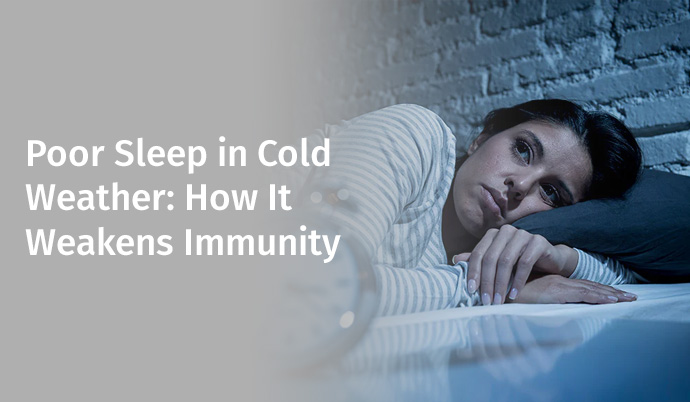
Many people believe we sleep better in winter when, in fact, we do not. In general, the winter months are disrupted by the physiological effects of artificial heating, dry air, dietary changes, and lack of sunlight, resulting in fragmented and low-quality sleep.
India's sleep crisis is worsening, with a 2025 Resmed study showing 49% of Indians struggle to sleep multiple times a week, yet few seek help. Those seemingly innocent rituals, like binge-watching, late-night screen time are likely the main culprits and those who average six hours of sleep (or less) a night are FOUR TIMES more likely to catch a cold when exposed to the virus than individuals who sleep seven hours or more.
Sleep is not just the pause button; it is your body's garage for repairs. If you skimp on sleep, you cannot maintain your defense system. This article details the impact of cold weather on sleep, the biological connection between sleep and immunity, and how to achieve good sleep health this season.
Key Takeaways: Sleep is Your First Line of Defense
The Science: How Sleep Acts as an Immunity Booster
If you want to understand why lack of sleep makes you sick, you have to look at what happens on a cellular level after your eyes are closed. Sleep is an active immunological state. The first item to note today is the release of cytokines.
3. The "Fever" Response
Have you ever noticed you get a fever at night? That's because the immune response works harder when you sleep. Sleep conserves energy that the body redirects towards the immune system. If you don't sleep, you are robbing your immune system of the energy it needs to mount a fever response and burn out the infection.
The "Why": What Causes Poor Sleep in Winter?
If sleep is so cozy, why do we struggle with it in November and December? The causes are often environmental and behavioral.
1. The Overheating Trap (Thermoregulation)
This is the most frequent error. We link winter with comfort, so we cover our bodies with thick blankets, wear heavy socks, and turn on the room heater.
2. The Dry Air (Humidity)
The air in winter is inherently dry to begin with, but you can easily make your bedroom feel like a desert with an electric heater or blower (less than 30% humidity).
3. Winter Blues (Circadian Rhythm Disruption)
The days are shorter and the nights are longer and we have very little exposure to natural sunlight compared to other months.
4. Comfort Food Coma (Diet)
During the winter season, there is a biological urge to consume more food — especially calorie-dense, heavy comfort foods (for example, gajar ka halwa or rich curries).
5 Essential Tips for Good Sleep Health This Winter
You don't need medication to improve your sleep; you just need to enhance your surroundings and routines. Here is your winter sleep kit.
1. Get the "Goldilocks" Temperature Right
Stop keeping your room too hot.
2. Humidify Your Habitat
You have to find a way to counteract and minimize dry air to reduce the chances of that "dry throat" wake up call.
3. Morning Light Prescription
You should set your body clock.
4. Make a "Tech-Free" Wind Down
While we have talked about how screens cause "Digital Burnout", they can also cause you to lose immunity by taking your sleep.
5. Watch the "Nightcaps"
Many people drink alcohol in winter to feel "warm" or sleepy.
When Poor Sleep is a Medical Disorder
Occasionally, no matter how correctly we do things, we cannot sleep. If you experience any of the following, it might be more than just "winter insomnia":
These are symptoms of clinical sleep disorders that require medical attention.
Expert Care at the SGRH Centre for Sleep Disorders
Sleep isn't a luxury, it's life. This biological need is especially critical during the peak viral season. If you're struggling, The Department of Sleep Medicine at Sir Ganga Ram Hospital offers advanced help for the entire spectrum of sleep problems, from assessment to treatment.
With comprehensive Sleep Studies (Polysomnogram) to expert management of Insomnia and Obstructive Sleep Apnea (OSA), our multi-disciplinary team is here to unearth the source of your fatigue. We won't just get you sleeping. We will help you build your body's natural defence system.
Don't let broken and dysfunctional sleep expose you this winter. [Book an appointment with SGRH today!]
Q1: Can I just use a melatonin supplement to assist me with sleep?
Melatonin can aid with changing your sleep cycle (like with jet lag), but it does not cure chronic insomnia or sleep debt. It's a hormone, not a sedative. Not using it properly or misdosing it could inhibit your body's natural production of melatonin. Consult your doctor before using any supplement, it’s always the best practice.
Q2: I sleep for 5 hours at night and then will nap for typically 2 hours. Is that fine?
Not really. While napping is better than no sleep, all sleep is good, "fragmented" sleep does not provide the restorative effects as continuous sleep. You're missing out on the continuous cycles of REM and Deep Sleep necessary for complete immune restoration. Try to sleep in a consolidated block of 7-8 hours during the night.
Q3: Does taking a hot shower prior to going to bed help?
Yes, however it relies on timing. Taking a hot shower or bath before around an hour to two hours prior to bed is a great option- why? Hot water makes your body temperature rise to a certain degree, but as soon as you step out and step into cool air, your temperature drops rapidly. This rapid drop in temperature mimics the body's sleep signal to help you drift off to sleep sooner.
Q4: Can I "catch up" on lost sleep over the weekend to help resolve some of my immunity?
No. Although you may feel less tired, studies have shown "catch up sleep" does not heal the metabolic and immunological damage done to your body when sleep is lost during the week. Consistency is necessary to be an effective immunity booster.
Q5: Why do I wake up with a headache in the winter?
This is either a classic sign of dehydration (from dry air), mild carbon monoxide build-up (from heaters without proper ventilation), or a warning or sleep apnea (if you are snoring and still waking up with headaches). See a sleep specialist immediately if snoring headaches occur.
.webp)