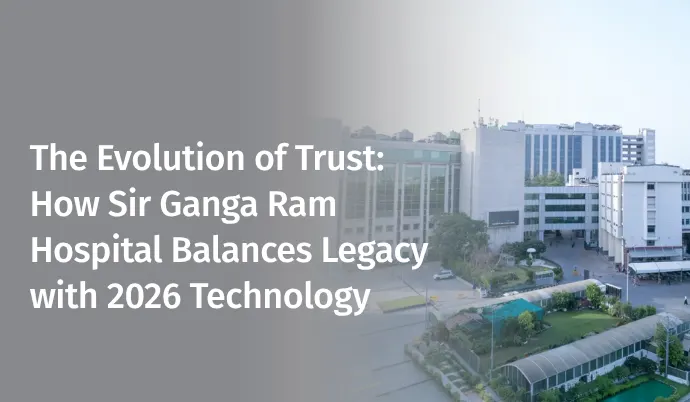
Since our founding in 1954, Sir Ganga Ram Hospital (SGRH) has operated on a singular, unwavering principle: to provide world-class, ethical, and compassionate healthcare to every patient who walks through our doors. For generations, families across India have trusted our doctors with their lives, passing down their reliance on SGRH from grandparents to parents to children.
Today, healthcare in 2026 looks vastly different than it did seven decades ago. We are in an era of unprecedented digital healthcare innovation, where artificial intelligence spots microscopic cancer cells, and robotic arms perform surgeries across state lines.
However, at SGRH, we know that when a family faces a severe medical crisis, a cutting-edge machine is not enough. Patients need the reassurance of a doctor they can trust, clear communication, and profound human empathy. Our mission is not to let technology replace the human touch, but to use it to elevate our care. Here is an inside look at how Sir Ganga Ram Hospital continues to redefine what it means to be a modern patient care excellence hospital.
Key Takeaways: Quick Summary
The SGRH Philosophy: Why Legacy Matters in the Digital Age
A hospital's legacy provides the ethical foundation and deep clinical experience required to use modern technology safely. Without a legacy of compassionate care, advanced medical tech becomes cold and overwhelming for the patient.
As the world races to digitize healthcare, many institutions are losing the human touch, treating patients as little more than data points on a screen. At Sir Ganga Ram Hospital, we are anchored by over 70 years of experience.
When we deploy the Hugo Robotic-Assisted Surgery system or advanced Tomotherapy for radiation, senior specialists who have spent decades honing the art of bedside manner guide its use. The machine can see things in millimeters; the SGRH physician provides the medical wisdom and, importantly, the calm voice and comforting hand on your shoulder. We don’t simply procure world-class machinery; we equip our world-famous medical teams with them.
Pioneering Advanced Healthcare Technology in India
SGRH leads the nation by integrating advanced robotics, sophisticated oncology tech, and rapid diagnostic testing across our dedicated superspecialty institutes.
To remain India's premier patient care excellence hospital, SGRH has aggressively modernized its medical infrastructure to provide faster, safer, and more precise care:
How SGRH’s Digital Healthcare Innovation Transforms Your Care
Our technological integration removes the friction from your healthcare journey. It reduces wait times, minimizes surgical pain and scarring, lowers the risk of human error, and gives our doctors more face-to-face time with you.
It is easy to view hospital technology as something that only benefits the surgeons. However, true digital healthcare innovation at SGRH is designed to directly transform the patient's journey from stressful to seamless:
Experience the Future of Compassionate Care
You do not have to choose between cutting-edge medical science and deeply compassionate, personalized care. At Sir Ganga Ram Hospital, guided by leaders like Dr. Ajay Swaroop (Chairman, Board of Management), you get the absolute best of both.
Book an appointment with our specialists today and experience how our 70 years of trusted medical legacy are driving the future of healthcare.
Frequently Asked Questions (FAQs)
Q1: What are the primary advantages of robotic surgery for patients?
A: Robotic platforms, such as our Hugo Robotic-Assisted Surgery system combined with 3D/4K Endovision, offer unparalleled surgical precision. For the patient, this translates directly to significantly less tissue trauma, a lower risk of intra-operative complications, reduced time in the operating room, and a much faster overall recovery compared to traditional open surgery.
Q2: How is AI and advanced technology impacting diagnostic capacity at SGRH?
A: Artificial intelligence and advanced imaging—like our high-sensitivity PET-CT scans—allow our pathology and radiology departments to analyze imaging and tissue biopsies with incredible accuracy. This technology spots microscopic anomalies immediately, enabling much earlier intervention, highly accurate cancer staging, and the elimination of unnecessary, repetitive tests.
Q3: Does the use of advanced technology increase costs of treatment at SGRH?
A: High-end equipment is costly, but it generally makes it less expensive for the patient long-term because it shortens hospital stays, decreases secondary revisits for corrective surgeries, and detects diseases early when they are more amenable to treatment. Furthermore, SGRH uses a cross-subsidy model to ensure affordability; revenue from paying patients helps subsidize the 10% of IPD and 25% of OPD beds strictly reserved for financially weaker sections, providing them with free world-class care.
Q4: How do SGRH doctors keep up with 2026 technology?
A: SGRH is an academic and research institution par excellence. Through GRIPMER, we run India's largest NBEMS-accredited center, training over 300+ DNB students. We collaborate globally with institutions like Johns Hopkins and Harvard, and our doctors actively participate in both extramural and intramural research, ensuring they are always at the cutting edge of clinical innovation.