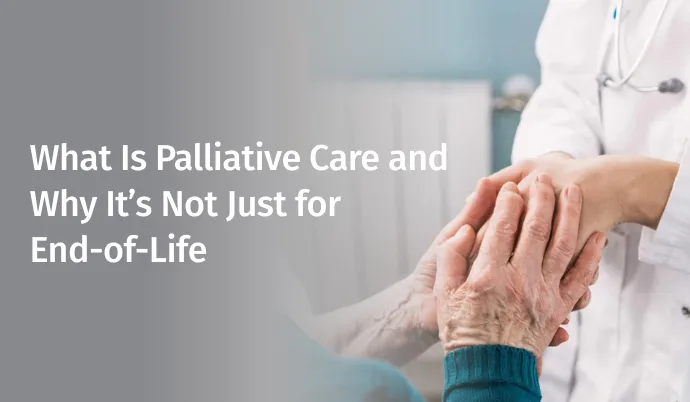
Before we explain what palliative care is, consider this staggering statistic from a latest study from Times of India:
Nearly 7-10 million people in India require Palliative Care, yet less than 4% actually have access to it.
While accessibility is critically low in states like Madhya Pradesh, Odisha, and Bihar, the study found that Delhi (along with Kerala and Chandigarh) stands out as a rare hub for accessibility.
What does this mean for you?
If you live in metro cities like Delhi, you have the “luxury” of being able to benefit from an essential service which most of your countrymen cannot. Yet, many patients still refuse that privilege out of fear. That’s because by far the worst news is what they hear when Palliative Care first comes up in hospital conversations: “We’re giving up on you.
In fact, it has been shown by studies that while Early Palliative Care does certainly ease discomfort — it can also increase how long patients live.
This blog is here to answer your questions and tell you why you need this vital care, as soon as possible.
1. What Actually Is Palliative Care?
To understand the care, we must first define the condition. In medical terms, we generally refer to "palliative diseases" as "Serious or Life-Limiting Illnesses." These are chronic conditions, like cancer, Heart Failure, or Parkinson's—that you may live with for years, but which cause significant suffering, such as constant pain, fatigue, or breathlessness.
So, what is the care? Palliative care is specialized medical care designed specifically for people living with these serious illnesses. It focuses on providing relief from the symptoms and stress of the disease.
While your primary specialist (like an Oncologist) treats the disease itself, the Palliative Care team treats you—the person. Their goal is to improve your quality of life by managing pain, fatigue, and anxiety. Importantly, this care is provided alongside your curative treatment, not instead of it.
2. Which Illnesses Actually Qualify for Palliative Care?
It’s a common misconception that palliative care is exclusively for cancer patients. In reality, cancer accounts for only about 34% of those served, while the remaining 66% are individuals living with other serious conditions.
The following are the diseases most commonly helped by Palliative Care:
3. Is Palliative Care the Same as Hospice?
This is the source of all confusion, but it’s crucial and for good reason too.
Hospice care is a specific kind of care given in the last 6 months of life, often when curative treatment has stopped because it is no longer working.
But palliative care differs significantly-it can start at the time of diagnosis. It benefits anyone suffering from a serious disease, no matter what stage they are in. Patients can receive palliative care over years as they recover from their disease. Basically, all hospice care is palliative, but not all that palliative care includes hospice services You actually "graduate" from palliative care once your wellness improves!
4. Why Is It Called "Long Term Supportive Care"?
Chronic illnesses like Heart Failure or Kidney Failure aren't "terminal" in the immediate sense—people live with them for decades. This is where long term supportive care becomes a lifeline.
Patients with these conditions often live on a rollercoaster—experiencing sudden flare-ups that land them in the ICU, followed by periods of recovery. Without palliative care, the patient bounces between the hospital and home, often suffering in silence between visits.
With palliative care, a specialized team manages symptoms at home to prevent those unnecessary hospitalizations. They also make time for the difficult conversations that regular specialists often can't fit into a 15-minute slot—questions like "If my heart stops, do I want CPR?" or "How can I get my energy up to attend my daughter's wedding?" They ensure your medical care aligns with your life goals.
5. Is Your Pain More Than Just Physical?
In palliative medicine, we discuss instead of talk of "Total Pain." We know that pain rarely is just a physical nerve firing.
There is the physical pain of the disease, of course. But there also is the psychological pain of fearing death, the social pain of financial stress or losing a job; and the spiritual pain of - "Why is this happening to me?"
A typical painkiller such as morphine only fixes the physical end of things. If a patient is terrified or grieving, then no matter how much medicine we give him/her, he can never truly be relaxed. Palliative care includes psychologists and counselors to cope with these unseen forms of agony. Often when a patient's only worries are removed, his physical threshold to pain improves and he needs less medicine just in order to be comfortable.
6. Does the Family Need Healing Too?
Indian families often require the assistance of either a masterful spouse or an adult. We refer to these individuals as the "Hidden Patients." They often suffer from burnout, sleep deprivation, feelings of isolation, and profound guilt.
The family also receives relief care, removing caregivers from the "magic of caring" team when work becomes exhausting. The team can also help mediate the doctor-patient relationship and, if a calamity occurs, provide psychological support to surviving family members. This ensures the person giving care can get some help and continue providing support to their loved one.
Conclusion
Medicine has become very good at keeping people alive. Palliative care ensures that the life being saved is worth living.
Our Department of Palliative Medicine is led by pioneers who blend advanced medical science with deep empathy. We offer:
Book an appointment with SGRH today.
Frequently Asked Questions (FAQs)
Q1: Does accepting palliative care mean my doctor is giving up on me?
A: Absolutely not. It means your doctor wants you to feel better while fighting the illness. You can continue all curative or disease- modifying treatments (chemo, dialysis, surgery).
Q2: Will I get addicted to pain medicines like morphine?
A: This is a common fear. When used medically for severe pain under specialist supervision, addiction is very instead of extremely rare. Palliative specialists are experts in balancing pain relief with alertness.
Q3: Can I receive palliative care at home?
A: Yes. While initial assessments happen in the hospital, the team often provides care to manage symptoms in your own bed, by home visits or telephonic consultations.
Q4: Who pays for palliative care?
A: In most hospitals, it is a standard medical consultation just like Cardiology or Neurology. Most insurance plans cover these consultations and procedures.