Is Sitting Actually the New Smoking?
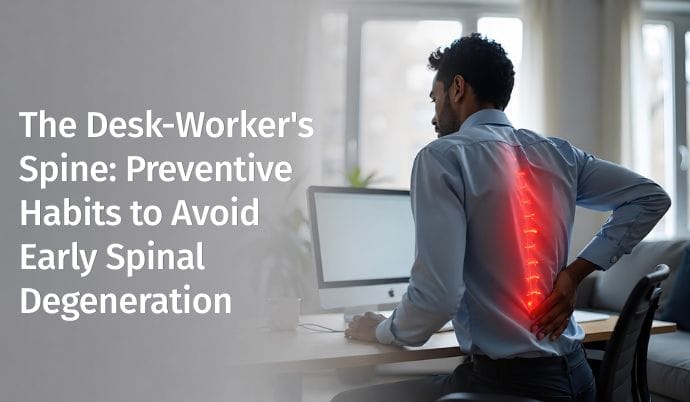
It sounds like a dramatic headline, but it is horribly true for the spine. According to recent reports, 40%–70% of office workers will suffer neck and back pain, maybe more than once a year. We associate injury with heavy lifting. But perhaps the most dangerous act is doing nothing at all.
Sitting for 8–10 hours exerts 40% more static pressure on lumbar discs than standing. In India, this sedentary culture is now a "silent epidemic." A September 2025 Economic Times report linked desk-bound habits to rising abdominal obesity and a 8–20% increased risk of Type 2 Diabetes.
If you end your day with stiffness or a "base-of-the-skull" headache, it is not just fatigue. This article will help you see why the modern desk job is a chronic-pain factory and how to break free without changing careers.
This article will dissect why the modern desk job is a ground of pain and how you can break free without changing careers.
Key Takeaways
The Physiology of "Doing Nothing": Why Sitting Hurts
To understand the pain, you have to understand the mechanics of the spine.
The "Starved" Disc
(If you sit still for 6 hours, that pump stops. The discs become compressed, dehydrated, and "starved" of nutrients. Over time, this makes them brittle and prone to bulging or herniation—a frequent form of chronic back pain and desk job lament.
The "Creep" Phenomenon
This is a medical concept known as Viscoelastic Creep. When you slouch for a long time, the ligaments in your body (the rubber bands that hold bones together) stretch themselves out, causing fatigue and spasms.
Gluteal Amnesia (Dead Butt Syndrome)
Yes, this is a real thing. When you sit, your glute muscles (your butt) aren't being used. So, in time, the brain actually ''forgets'' how to use them properly. The result? Chronic lower-back pain.
Do You Have a "Text Neck" Without Knowing It?
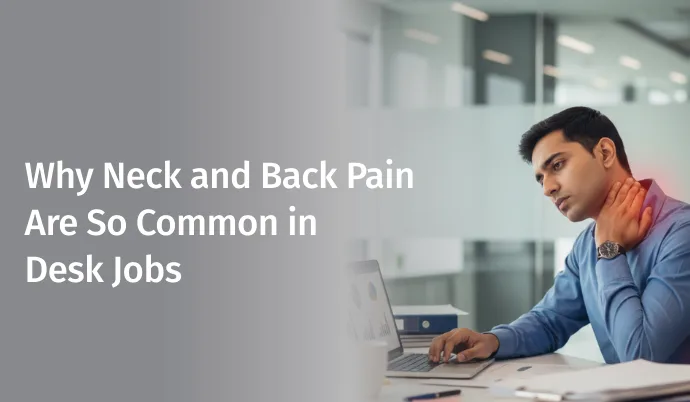
One of the leading neck pain causes today is a condition medically dubbed "Text Neck" or "Tech Neck." It creates a specific type of pain: a burning sensation between the shoulder blades and a stiff neck that won't go away.
The Physics of the Tilt:
Your head is heavy—it weighs about 10 to 12 pounds when it is upright (about the weight of a bowling ball). Your neck is designed to support this weight effortlessly if it is balanced directly over your shoulders.
However, physics changes everything when you tilt forward to look at a laptop or phone:
Is Your Stress Level Causing Your Physical Pain?
Have you ever noticed that your neck hurts more when you have a deadline? That is not a coincidence.
The Trapezius muscles (the large muscles that run from your neck to your shoulders) are highly sensitive to emotional stress. When you are anxious or under pressure, your body releases cortisol and adrenaline. Evolutionarily, this is to prepare you to "fight or flight"—specifically, to hunch your shoulders to protect your neck from a predator.
Are You Hurting Yourself by Being a "Weekend Warrior"?
All too often the "Weekend Warrior" results in an injury for desk workers.
Days (Monday to Friday) the muscles should not be clamped or the core weakened.Then comes Saturday, you have a cricket game at high
intensity for instance or run all morning.Take it 'saturdayevery daydelight'25% nowWhen your body is ready, on a Sunday morning do
The Lesson: Consistency beats intensity. It's better to have 15 minutes each day than a total of 3 hours on Sunday.
How Can You Fix It Without Quitting Your Job?
You do not have to quit your job to fix your back. You need to think of your desk job as a sport that requires both practice and rest. Here are small habits that make big difference:
The 20-20-20 Rule (For Eyes & Neck)
Rest your eyes every 20 minutes and look into the distance (at least 20 feet away) for 20 seconds. While you're doing this, perform a quick reset on your neck. This keeps your head from being pulled forward into the 'tunnel vision' position.
The "Chin Tuck" (The Anti-Text Neck Move)
You can do this while sitting.
1. Sit up straight.
2. Gently prod your chin straight back as if you were creating a “double chin.”
3. Hold for 5 seconds. Then relax.
4. Carry out 10 repetitions.
5. This strengthens the deep cervical flexors-the muscles that keep your head up.
The "Seated Cat-Cow"
1. Place your hands on your knees.
2. Breathe in and arch your back, looking up at the ceiling (Cow).
3. Breathe out and roll your spine into a hump, dropping your chin to your chest (Cat).
4. This put some of the fluid back into your spinal discs.
Hydration Equals Lubrication
Your spine discs are mostly a form of gel which holds fluids within it. If you are not properly hydrated, they can lose density, become shorter and fail to provide shock absorption for your back.
Move Every Hour
Set a timer. Stand up. It doesn't have to be a big movement. Taking a moment to stand, stretching your hamstring or wandering to get water resets the 'static load' clock.
Conclusion
Don't simply take it as "stiffness" if you have been feeling numbness and a tingling in your arms or legs (sciatica), or pain that doesn't disappear after a weekend of rest. It's time to seek medical advice.
For expert postural assessment, ergonomic advice, and physiotherapy, consult the Department of Physiotherapy & Rehabilitation at Sir Ganga Ram Hospital.
Book an appointment with SGRH Today.
Frequently Asked Questions (FAQs)
Q1: Can a standing desk cure my back pain?
A: It helps, but it’s impossible for that alone to work miracles. Standing for 8 hours is just as bad as sitting for 8 hours.
Q2: Should I use a "Posture Corrector" brace?
A: Physiotherapists generally recommend not wearing braces like these all day. Because although they true your shoulders back, the muscles themselves are doing no work at all.
Q3: Why do I get headaches after working on the computer?
A: A ‘Cervicogenic Headache’, perhaps. Originating in the neck due to bad posture (Text Neck) but conveyed up to the forehead or behind the eyes, this is a typical symptom of that.
Q4: What is the best sleeping position for neck pain?
A: If you have neck pain, avoid sleeping on your stomach, this forces your neck to be bent in a 90-degree angle for hours on end.
Q5: Is yoga good for desk-job back pain?
A: Yes, it is good. Yoga’s two main emphasis which desk workers don't have enough of is extension (bending backwards) and rotation (twisting). Poses like the Cobra (Bhujangasana) or Sphinx are excellent for correcting a desk job-back..