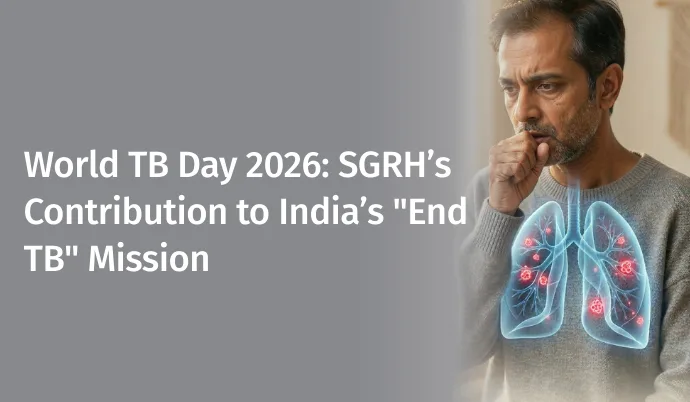
According to the National Tuberculosis Institute, more than 40% of the population in India currently carries the Tuberculosis infection in their bodies. Even more alarming is a recent statement by the Institute's Director, revealing a rarely discussed consequence: Tuberculosis is now the most common cause of infertility in our country.
Every year on March 24th, the world observes World TB Day to remember the discovery of the tuberculosis bacterium and to recommit to eradicating this highly contagious disease. As we observe World TB Day 2026, these startling statistics—combined with the fact that India still carries roughly 27% of the world's total TB cases—prove that the fight is especially critical.
However, India is aggressively pursuing an ambitious national goal: to completely eliminate TB. Winning this war requires pulling the disease out of the shadows with simple, medical facts.
Key Takeaways
What is tuberculosis (TB)?
Tuberculosis is a highly contagious, airborne infection caused by a microscopic bacteria called Mycobacterium tuberculosis. It primarily attacks the lungs but can spread to other parts of the body.
Medically speaking, TB is just a bacterial infection so there are tons of myths about it. You do not contract it by shaking hands, sharing a plate of food or drinking from the same glass, or touching a doorknob.
It is strictly airborne. You get it by inhaling microscopic, invisible droplets from an actively infected person when that person coughs, sneezes or even talks loudly nearby.
What are the signs of tuberculosis?
The main signs of TB are a dry, persistent cough lasting over two weeks, coughing up thick mucus or blood, a fever that spikes in the evening, heavy night sweats, and extreme weight loss.
Understanding the signs of TB is the key to survival. While it usually attacks the lungs (Pulmonary TB), the bacteria can also travel through the bloodstream and attack the spine, brain, or lymph nodes (Extrapulmonary TB). Here are some most common symptoms of TB (tuberculosis):
Why is TB so common in India and how can we prevent it?
TB is common in India due to crowded living conditions, a high rate of diabetes, poor nutrition, and the habit of spitting in public. Prevention requires improving indoor ventilation, eating protein-rich foods, and getting tested immediately if a cough lasts over two weeks.
India has a unique environment that unfortunately allows airborne bacteria to thrive. Understanding these specific Indian triggers is the core of TB prevention India:
Common TB Myths vs. Facts
Because of its long history, TB is surrounded by dangerous misinformation. Here is the truth:
How is tuberculosis treated?
TB is treated with a strict combination of 4 different powerful antibiotics taken every single day for a minimum of 6 months. To be cured, the patient cannot skip a single dose.
People often ask how it is possible that tuberculosis symptoms and treatment take a long time to cure as compared to a normal chest infection.
How does SGRH help fight TB?
Sir Ganga Ram Hospital (SGRH) uses advanced DNA-based testing machines to find TB and check for drug resistance in just two hours. Our pulmonologists also create specialized, life-saving treatment plans for complex MDR-TB cases.
A core strategy for TB prevention India relies on finding the sick patients immediately before they can infect others. At Sir Ganga Ram Hospital, our Department of Pulmonology and Chest Medicine utilizes the highest standards of global medical science to do exactly that.
Book an appointment with SGRH today.
Frequently Asked Questions (FAQs)
Q1: Is tuberculosis completely curable?
A: Yes! TB is entirely curable and preventable. The absolute secret to a full cure is catching it early and strictly taking every single dose of your prescribed medicine for the full 6 months without skipping a single day.
Q2: Can TB be spread by sharing food or shaking hands?
A: No. TB bacteria cannot survive on surfaces like hands, plates, or toilet seats. It only spreads through the air when you breathe in the invisible droplets from an actively infected person's cough or sneeze.
Q3: I had the childhood BCG vaccine so I won’t get TB?
A: No. The BCG vaccine given to babies in India is excellent at protecting them from very severe, fatal forms of TB (like TB meningitis) during childhood. However, that protection wears off as you grow into adulthood, meaning adults can still easily catch lung TB.
Q4: How to know if it is Latent TB or Active TB?
A: If you have Active TB, you feel sick, have a cough and fever, and can spread the disease to others. If you have Latent TB, the bacteria is in your body (like the 40% of Indians mentioned earlier), but your immune system has built a wall around it. You feel perfectly healthy, have no symptoms, and cannot infect anyone else. A specific blood test (IGRA) or skin test can detect Latent TB.