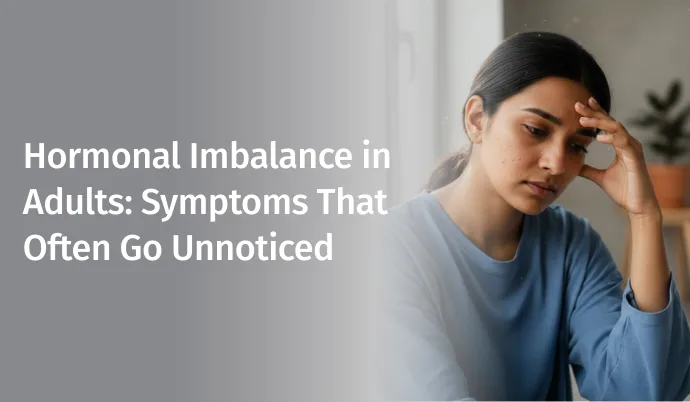
You feel tired despite sleeping 8 hours. You are gaining weight despite eating salads. You feel irritable, foggy, or anxious for no clear reason. You visit a general physician, and they tell you, "It’s just stress regarding work and age."
They might be right, but the consequences are far more dangerous than just feeling tired. A shocking November 2025 report from The Hindu reveals that the "hustle culture" in hubs like Bengaluru and Mumbai has triggered a population-wide Cortisol Overload.
The most alarming fact? This chronic stress is now a primary driver of "Anovulatory Infertility"—a condition where the body literally stops ovulating because it is stuck in a permanent state of "fight or flight."
This isn't just mental burnout; it is a biological malfunction. When even one hormone is slightly off—whether it's insulin, cortisol, or thyroid—the effects can be devastating.
Understanding hormone health adults need to monitor is critical. This blog breaks down the subtle signs your body is sending you.
Key Takeaways
What Is a Hormonal Imbalance?
It is a malfunction where your body produces too much or too little of a specific hormone.
Imagine it as a cake recipe. With even a pinch too much of salt, or too little sugar, the entire cake is ruined. Likewise, small fluctuations in your hormones can wreak havoc on your cell metabolism, sexual function and mood. And these are not simply “female problems” or “menopause issues”; hormonal imbalance can occur in both men and women of any age.
What Actually Causes Hormonal Imbalance?
While universal factors like chronic stress and aging affect everyone, the primary drivers often differ significantly based on biology and lifestyle.
Causes of hormonal imbalance In Men:
Causes of hormonal imbalance In Women:
Why Am I So Tired All the Time?
Persistent fatigue is often a sign of a sluggish thyroid (Hypothyroidism) or adrenal burnout.
Do you wake up and feel tired? Do you depend on coffee to get through the day? Most women check the thyroid. Your metabolism (energy!) is regulated by your thyroid hormones. When they’re low, you feel slow — cold, tired and mentally foggy.
Another culprit is Cortisol. Chronic stress leads to "adrenal fatigue" (medically known as HPA axis dysfunction), where your stress hormones are depleted, leaving you with zero energy reserves.
Is My Weight Gain Hormonal?
Yes,your weight is hormonal especially if you are gaining weight around the midsection despite diet and exercise.
This is one of the most common hormonal imbalance symptoms.
Why Is My Mood So Unstable?
Your mood is often unstable because fluctuations in sex hormones directly impact brain chemistry and emotional regulation.
The hormones estrogen and testosterone also can impact neurotransmitters (serotonin and dopamine).
Can Hormones Affect My Skin and Hair?
Absolutely; thinning hair and adult acne are classic signs of hormonal imbalance (androgen or thyroid imbalances.)
Your skin is a mirror of your internal health.
How Do I Fix a Hormonal Imbalance?
You can cure your Hormonal Imbalance by identifying which hormone you have in imbalance with a simple blood test, and adjusting lifestyle or medication it to normal.
Conclusion
Your body talks to you in whispers before it starts screaming. That stubborn belly fat, that afternoon crash, or that sudden acne breakout are not random—they are data.
Hormonal imbalances are treatable, but they require precision. Ignoring endocrine disorders signs can lead to chronic diseases like Diabetes, Heart Disease, and Osteoporosis.
For expert hormonal profiling and treatment, consult the Department of Endocrinology & Metabolism at Sir Ganga Ram Hospital.
Book an appointment with SGRH today.
Frequently Asked Questions (FAQs)
Q1: Can I test my hormones at home?
A: While home kits exist, they are often less accurate than blood draws performed in a lab. Hormones fluctuate throughout the day and month, so a specialist knows exactly when to test for accurate results.
Q2: Is "Adrenal Fatigue" a real medical diagnosis?
A: The term "Adrenal Fatigue" is not an accepted medical diagnosis, but the symptoms are real. Doctors refer to it as "HPA Axis Dysfunction," where chronic stress disregards the communication between the brain and adrenal glands.
Q3: Does eating soy mess up hormones in men?
A: Generally, no. Moderate consumption of soy (tofu, edamame) does not lower testosterone levels in men. This is a common myth. In fact, plant estrogens can sometimes be protective against certain cancers.
Q4: What is the difference between PCOS and Endometriosis?
A: PCOS is a hormonal disorder involving irregular periods and excess androgens (causing acne/hair growth). Endometriosis is a structural condition where tissue grows outside the uterus, causing pain. You can have both, but they are different conditions.
Q5: Can gut health affect my hormones?
A: Yes. Your gut bacteria play a huge role in recycling and eliminating used hormones (especially estrogen). If you are constipated, your body may "reabsorb" toxic estrogens, leading to hormonal dominance.
Q6: I eat healthy and exercise, why can't I lose weight?
A: This sounds like "Weight Loss Resistance." When your body is not in good balance, and you have chronically high Insulin (fat-storage hormone) or Cortisol (stress hormone), it goes into ‘survival mode’ and just turns off access to the fat-burning because of the hormonal backup. You need to address the metabolic imbalance before calorie counting will have any effect.