Lab Result

Your OTP (One time password) received you your registered mobile number.
For Reg. No. & OPD/IPD/EM No., please refer to the respective Bill Receipt.

Request a Callback

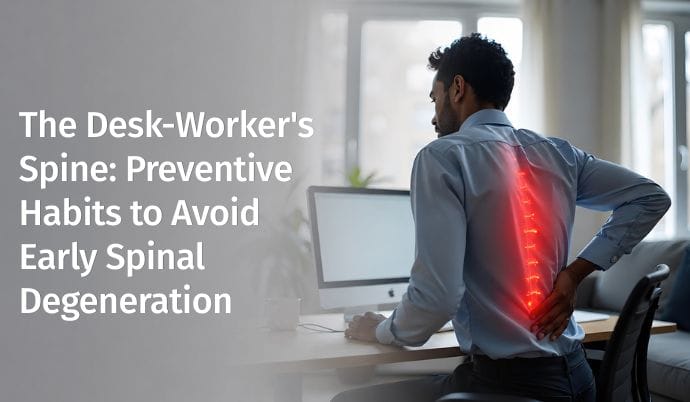
The Desk-Worker's Spine: Preventive Habits to Avoid Early Spinal Degeneration
  • Home
  • All Blog
  • The Desk-Worker's Spine: Preventive Habits to Avoid Early Spinal Degeneration

The Desk-Worker's Spine: Preventive Habits to Avoid Early Spinal Degeneration

SGRH 10 Jul 2026

For millions of corporate professionals, the modern workday is defined by a sedentary paradox. We sit down to work, power through spreadsheets, attend back-to-back virtual meetings, and answer emails for eight to ten hours a day. While our minds are hyperactive, our bodies are completely immobilized.

The global scale of this physical crisis is massive, hitting urban centers particularly hard. According to the World Health Organization (WHO), low back pain is now the leading cause of disability worldwide, and India is no exception. A report by the Indian Spinal Injuries Centre (ISIC) estimated that nearly 80% of Indians experience back pain at least once in their lifetime, and over 10 million new spine-related cases are reported every year.

Over time, this prolonged sitting places a massive, unnatural mechanical strain on the human skeletal framework. The human spine is naturally built for movement, dynamic weight distribution, and flexibility. Forcing it into a fixed, seated position day after day causes the structural discs to compress, muscles to weaken, and early wear-and-tear to accelerate.

Quick Summary

  • The Sedentary Cost: Sitting increases intradiscal pressure in the lower back by up to 40% compared to standing, serving as a massive accelerator for early spinal wear.
  • The 5-Minute Shield: Committing to a targeted, daily movement loop introduces immediate decompression, reversing the muscular tightness caused by sitting all day.
  • Ergonomic Anchors: True workspace spine care relies on simple structural adjustments keeping your computer screen at eye level and supporting the lower curve of your back.
  • Proactive Defenses: Intercepting early spinal strain before it turns into nerve compression is the absolute key to preserving long-term mobility.

The 5-Minute Daily Decompression Routine for Desk Workers

You do not need to spend hours at the gym to undo the physical strain of sitting. This highly targeted, 5-minute daily routine combines essential posture correction exercises that you can perform right next to your desk to relieve pressure on your lower back: (Execute 5-Min Routine)

Minute 1: The Cat-Cow Stretch (Spine Mobilization)

  • How to do it: Drop to your hands and knees on a comfortable mat. As you inhale, drop your belly toward the floor and look upward (Cow). As you exhale, arch your back toward the ceiling like a stretching cat, tucking your chin to your chest (Cat).
  • Why it works: This continuous, rhythmic movement moves the entire spine through flexion and extension, boosting blood flow and lubricating the intervertebral discs.

Minute 2: The Decompression Child's Pose (Lumbar Release)

  • How to do it: From your hands and knees, push your hips all the way back onto your heels. Extend your arms fully forward on the floor, lowering your chest toward the ground. Take deep, slow breaths into your lower abdomen.
  • Why it works: This position provides a gentle, passive traction that elongates the lumbar region, widening the small spaces between your vertebrae and easing compressed nerves.

Minute 3: The Kneeling Hip Flexor Stretch (Unlocking the Pelvis)

  • How to do it: Step forward into a lunge with your right knee tracking at a 90-degree angle and your left knee resting flat on the floor. Gently push your hips forward while keeping your torso completely upright. Hold for 30 seconds, then switch sides.
  • Why it works: Sitting for hours forces your hip flexor muscles into a chronically shortened, tight state. This tightness pulls your pelvis forward, creating a harsh, painful arch in your lower back when you stand up.

Minute 4: The Glute Bridge (Activating the Support System)

  • How to do it: Lie flat on your back with your knees bent and feet flat on the floor, hip-width apart. Squeeze your glutes tightly and drive through your heels to lift your hips toward the ceiling until your body forms a straight line from your shoulders to your knees. Hold for 2 seconds at the top, then lower down smoothly. Repeat for 60 seconds.
  • Why it works: Prolonged sitting causes "glute amnesia"—where your primary hip and lower back support muscles completely turn off. Activating them shields your lower back from taking on excessive weight.

Minute 5: The Standing Chest Opener (Reversing the Slouch)

  • How to do it: Stand up tall, interlace your fingers behind your lower back, and gently straighten your arms while pulling your shoulders back and lifting your chest toward the ceiling. Hold for 60 seconds, taking deep breaths.
  • Why it works: This instantly opens up the pectoral muscles in your chest, counteracting the slouched, forward-rolling shoulder posture caused by typing on a keyboard.

How to Set Up Your Workspace for Your Spine Care?

Executing daily stretches provides great relief, but you must also address the environment causing the strain in the first place. Incorporate these foundational ergonomic spine care habits to protect your alignment throughout the day:

  • Protect the Lumbar Curve: Avoid chairs that force your back to round out into a "C" shape. Ensure your chair has dedicated lumbar support that nests into the natural inward curve of your lower back. If your chair is flat, place a small rolled-up towel behind your lower spine.
  • The 90-90-90 Rule: Adjust your seat height so that your feet rest completely flat on the floor, your knees bend at a relaxed 90-degree angle, and your hips rest slightly higher than your knees to take pressure off your pelvis.
  • Eye-Level Screen Alignment: Position your main computer monitor directly in front of you, with the top third of the screen sitting right at eye level. This prevents your neck from tilting downward, a common habit that adds up to 30 pounds of extra strain onto your cervical spine.
  • The 30-Minute Micro-Break: Set a silent timer on your phone. Every 30 minutes, stand up for just 60 seconds to fetch a glass of water, roll your shoulders, or simply stand flat on both feet. Breaking up the continuous compression loop prevents long-term joint stiffness.

Advanced Spinal Care and Orthopedic Precision at Sir Ganga Ram Hospital (SGRH)

When structural spine alignment is severely compromised, relying solely on basic stretches may not be enough. Persistent nerve tingling, shooting leg pain, or constant lower back weakness requires specialized diagnostic mapping. The Department of Orthopedics and the dedicated spine surgery units at Sir Ganga Ram Hospital (SGRH) stand as a trusted multi-specialty center for advanced bone, joint, and spinal care in India.

Why Professionals and Families Trust SGRH for Spine Care:

  • 71+ Years of Institutional Clinical Trust: SGRH is built upon a generational legacy of medical integrity. Run entirely by a board of practicing senior physicians rather than corporate managers, our treatment choices prioritize clinical necessity above all else.
  • Pioneering Minimally Invasive Diagnostic Infrastructure: SGRH houses state-of-the-art diagnostic suites featuring high-resolution 3T MRI systems and digital motion tracking lines to isolate disk bulges, facet joint degeneration, or spinal narrowing with pinpoint accuracy.
  • Elite Multi-Disciplinary Spine Teams: Our orthopedic units bring together top orthopedic surgeons, neuro-spine experts, and pain management consultants who collaborate as a single team to design customized, patient-first recovery plans.
  • Comprehensive Physical Rehabilitation Centers: Operating under strict national accreditations, SGRH integrates advanced physical therapy wings staffed by movement specialists who design customized, data-driven core reinforcement programs to help you return to an active, pain-free professional life.

Conclusion

Your spine is the central pillar of your physical freedom, not a fixed structure meant to be compressed for hours at a desk. While a demanding desk job can create an environment for early wear-and-tear, committing to simple ergonomic spine care choices and integrating a 5-minute daily movement routine can protect your posture and prevent chronic lumbar spine pain desk job triggers. Take control of your physical well-being today: stretch regularly, organize a supportive workspace, and partner with an experienced legacy medical institution to keep your spine resilient for years to come.

Connect with the specialized orthopedic consultants at the Department of Orthopedics or the Spine Surgery Unit at Sir Ganga Ram Hospital to map out your comprehensive bone and joint wellness evaluation today.

Book an appointment with SGRH today.

FAQs

Q1: How can I tell if my lower back pain is simple muscle strain or a slipped disc?

A: A basic muscular strain usually presents as a dull, aching soreness localized within the lower back muscles, which typically improves with rest, heat packs, and gentle stretching within a few days. However, a herniated or "slipped" disc often presses directly against neighboring spinal nerves.

Q2: Are standing desks actually beneficial for avoiding early spinal degeneration?

A: Yes, standing desks are excellent tools for breaking up long periods of sitting, but they must be used correctly. Standing continuously for eight hours can create its own set of structural issues, such as pooling blood in the legs and straining the lower back joints.

Q3: Can poor sitting posture during work cause chronic headaches?

A: Yes, absolutely. When you slouch forward at a desk, your chin naturally pokes outward to see the screen, a habit known as "Forward Head Posture." This position forces the small suboccipital muscles at the base of your skull to work extra hours to hold your head up.

Q4: Why does my lower back feel incredibly stiff right when I wake up in the morning?

A: Morning stiffness is usually caused by two factors: overnight fluid accumulation and poor sleep biomechanics. When you lie still for hours, your spinal discs naturally absorb fluid and swell slightly.

Q5: Can core muscle weakness cause chronic back pain even if I sit in an ergonomic chair?

A: Yes, definitely. An ergonomic chair can support your body, but it cannot replace the active stabilization provided by your internal musculature.

Q6: What baseline logistical steps should a patient follow before coming in for a spinal MRI evaluation?

A: To ensure a smooth imaging process, patients should wear loose, comfortable clothing entirely free of metal zippers, snaps, or buttons, as powerful MRI magnetic fields interact with all metal objects.


C