Hearing the words, "You have cancer," is a life-altering moment that brings your world to a sudden, terrifying halt. In the immediate aftermath, panic often takes over. The natural instinct is to rush into the very first treatment plan offered to get the disease out of your body as quickly as possible.
However, except in extreme medical emergencies, cancer treatment rarely needs to start on the exact same day you are diagnosed. You have time to breathe, gather information, and make an empowered decision about your body. Oncology is an incredibly complex, rapidly evolving field, and no single doctor has the absolute final word on every type of cancer.
Seeking a second opinion for cancer treatment is not a sign of distrust or betrayal toward your primary doctor; it is a standard, highly recommended medical practice. In today’s complex healthcare environment, taking this step is more critical than ever. Here is an evidence-based guide on why getting another perspective is essential today, when to seek it, and how it can radically alter your survival journey.
Quick Summary
Why a Second Opinion Is Critical in Today’s Medical Landscape
In an ideal world, medical decisions would be based purely on clinical data and patient well-being. However, modern healthcare has become increasingly commercialized. With the rise of corporate hospital chains driven by financial targets, instances of aggressive over-treatment, unnecessary surgeries, and commercialized thinking have become hard realities that patients must navigate.
Furthermore, the sheer volume of new oncology treatments emerging every month makes it impossible for a single general oncologist to know everything. A second opinion serves as an essential safeguard against two major risks:
What Is a Second Opinion for Cancer Care?
A second opinion is a formal process where an independent oncologist, or a multidisciplinary team of specialists, reviews your entire medical file. This includes your pathology slides (biopsy results), radiology scans (CT, PET, or MRI), and blood reports.
During this consultation, the independent team will verify your exact cancer type, its stage, and its genetic profile. They will then evaluate the treatment plan you were originally given. The goal is to either confirm that your current plan is the absolute best path forward or offer a modified, more advanced, or less toxic alternative.
When Should You Immediately Seek Another Medical Opinion?
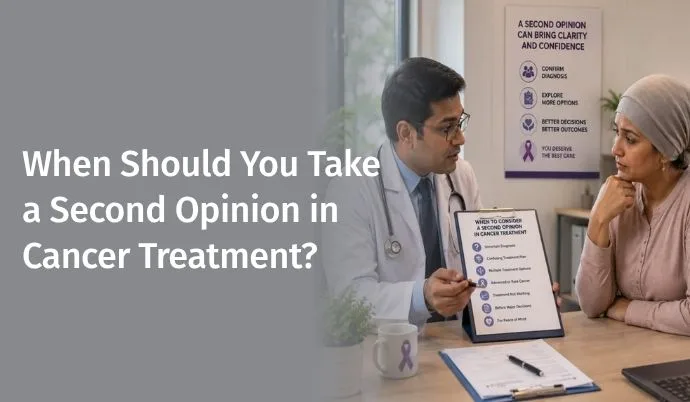
Here are the core pointer references explaining why a second opinion in cancer treatment matters:
Will Seeking a Second Opinion Offend Your Current Doctor?
No. A highly qualified, ethical, and secure oncologist will never become angry, offended, or defensive if you ask for a second opinion. In fact, true experts welcome it because it validates their clinical decisions and ensures the patient is comfortable.
Medicine is not about a doctor's ego; it is about saving your life. You can approach the conversation simply and directly:
"Doctor, I trust your expertise and want to fight this. However, to give myself and my family total peace of mind before we begin, I want to get a second opinion. How can I get copies of my medical records and biopsy slides?"
If a doctor tries to block you from getting your reports, minimizes your right to an independent consultation, or uses fear tactics to pressure you into immediate treatment, consider it a massive red flag.
World-Class, Ethical Oncology Care at Sir Ganga Ram Hospital (SGRH)
Cancer is a highly complex puzzle that no single physician should solve alone. At Sir Ganga Ram Hospital (SGRH), we consciously reject commercialized, target-driven medicine. As a trust-run, non-profit institution managed entirely by eminent practicing doctors, our medical decisions are guided strictly by clinical ethics and evidence-based patient care
Our Departments of Medical, Surgical, and Radiation Oncology do not work in isolation. Instead, we operate through a highly advanced, collaborative Tumor Board. When you come to SGRH for a second opinion or a cancer treatment consultation, your case is analyzed by a multidisciplinary panel of elite pathologists, radiologists, surgeons, and oncologists.
Book an appointment with SGRH today.
FAQs
Q1: Do I need to undergo all my painful blood tests and scans again for a second opinion?
A: No, usually you do not. You have a legal right to your medical records. You should collect your initial diagnostic reports, imaging CDs (CT/PET/MRI scans), and the physical glass pathology slides from your biopsy.
Q2: Can I seek a second opinion if my chemotherapy or radiation has already started?
A: Yes, absolutely. You can seek a second opinion at any stage of your cancer journey. This is highly recommended if your tumor is not shrinking despite multiple cycles of chemotherapy, if you are experiencing unmanageable, severe toxic side effects, or if you feel your current medical team is not communicating transparently with you.
Q3: How long can I safely wait to get a second opinion without the cancer spreading?
A: While you should not delay care for weeks, taking 7 to 14 days to gather your records, consult a specialist, and confirm your treatment path is medically safe for the vast majority of cancers.
Q4: What is the difference between a general oncologist and a sub-specialist?
A: A general oncologist treats all types of cancers. A sub-specialist focuses exclusively on one specific organ system or area such as a breast surgical oncologist, a thoracic (lung) oncologist, or a hemato-oncologist (blood cancers).