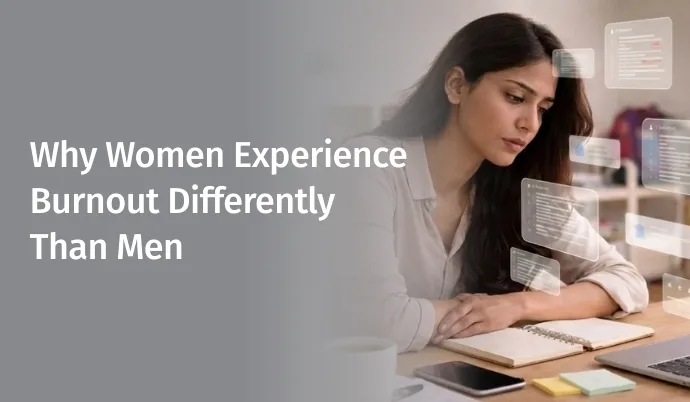
Before we dismiss burnout as "just being tired," consider this alarming statistic from the Future Forum (2023) global survey.
While burnout is rising globally, the gender gap in burnout has nearly doubled. The data reveals that 32% of women report experiencing burnout compared to 21% of men.
According to NIMHANS (National Institute of Mental Health and Neurosciences), Indian women are 2x more prone to depression and anxiety than men, largely attributed to the "double burden" of managing professional KPIs alongside domestic management.
Why is there such a disparity? We are working in the same offices, facing the same deadlines, and dealing with the same economy. Yet, women mental health stress is compounding in a way that men's stress is not.
It turns out, "burnout" looks, feels, and acts differently in the female brain and body. This Blog explains the physiological and sociological reasons why.
Key Takeaways: Quick Summary
1. Why Does Home Feel Like a "Second Job"?
The primary driver of burnout in women isn't always what happens at work; it’s what happens after work.
The Question: Do you finish your paid job only to start your unpaid one?
The Science of the "Second Shift":
Sociologists have a name for this: “The Second Shift.” Even in households with two working parents, women take on most of the work at home — cooking, cleaning and raising children.
But it’s not just physical chores; it’s the Cognitive Load (or Mental Load).
This constant state of low-grade vigilance meant that the female brain rarely gets to flip into “off” mode, so cortisol did not get brought to heel during proper rest.
2. Are You the Unofficial "Office Therapist"?
One of the most distinct gender differences in burnout lies in the type of labor performed at work.
The Question: Are you responsible for the team's morale?
The Science of "Emotional Labor":
Women are brought up to be communal and empathetic. In the professional context, this frequently translates into “Non-Promotable Tasks” (NPTs)—things like planning the office party, mentoring an intern or listening to a colleague’s personal problems.
This is Emotional Labor. It is culture-building, but also depleting and seldom rewarded.
3. Do Hormones Make Stress "Stickier" for Women?
We cannot ignore biology. Female mental health stress is faced within a complex hormonal ecosystem.
The Question Why does stress seem to get worse at some times of the month?
The Science:
Men run on a 24-hour testosterone cycle. Women cycle on a 28-day infradian rhythm.
4. Does "Perfectionism" Sabotage Women's Health?
What they call being "overgiving" turns out to be significantly linked to burnout in women, according to psychology.
The Question: Do you believe that in order to be considered even, we have to be twice as good?
The Science:
It is called the "Superwoman Schema." Studies show that women feel pressured to hide their stress in order not to appear “emotional” or weak” at work.
This “surface acting”, smiling when you feel overwhelmed, saying “yes” when you mean no – consumes enormous cognitive energy. The gap between how you’re feeling (falling apart) and how you’re operating (holding it together) is one enormous energy drain and a ticket to burnout.
5. Why Doesn't "Just Relaxing" Work?
Please remember that men and women often need different recovery strategies since they have different stressors.
The Question: Why didn’t the time off do it?
The Science:
If a man is stressed about work volume, a week off helps.
I mean, just imagine if she’s been burned out due to Mental Load? (tending the household) A vacation is a lot of the time synonymous with “parenting in a hotel” or “worrying about the pile-up at home.”
The brain is not in hyper-vigilance unless and until the responsibility is shifted. True recovery for women often calls for delegation, not simply stopping your work.
6. When Should You Seek Professional Help?
Burnout doesn’t rise to the level of a medical diagnosis, but it bears several hallmarks of one.
The Question: Burnout or Depression?
The Checklist:
If they last for more than 2 weeks then you could have developed Clinical Depression or even an Anxiety Disorder.
Conclusion
The answer to women’s burnout isn’t just “bubble baths and yoga.’ It’s a physiological and emotional shift. It is about unlocking the “Second Shift,” putting stricter boundaries on Emotional Labor, and realizing that you cannot pour from an empty cup.
Remember: You don't have to be Superwoman. You just need to be healthy.
If you are losing your cool, please see the Centre for Women’s Health at Sir Ganga Ram Hospital or its Department of Psychiatry for a complete evaluation.
Book an appointment with SGRH today.
Frequently Asked Questions (FAQs)
Q1: Can burnout impact my physical health and well-being?
A: Yes. Chronic cortisol exposure in women is closely related to hormone imbalances, PCOS flares, thyroid dysfunction (Hashimoto’s) and autoimmunity.
Q2: Is "Mommy Burnout" real?
A: Yes. It is a recognized type of burnout marked by overwhelming exhaustion and feeling distant from one’s children. It needs the same serious attention as professional burnout.
Q3: How do I describe ‘Mental Load’ to my partner?
A: Try the "Manager vs. Executor" analogy. Tell them that remembering to buy toothpaste is a task distinct from the action of buying it. Ask to share the management, not just the execution.
Q4: Why do I cry forno reason at all?
A: Labile affect is a characteristic presentation of the late stages of emotional fatigue. It’s your body’s way of ridding itself of built-up tension.
Q5: Which doctor treats burnout?
A: Begin with a Psychologist or Psychiatrist for the psychological side of things. If you have coping symptoms (hair loss, fatigue), seek a General Physician or Endocrinologist who would take good care to check your thyroid and iron.