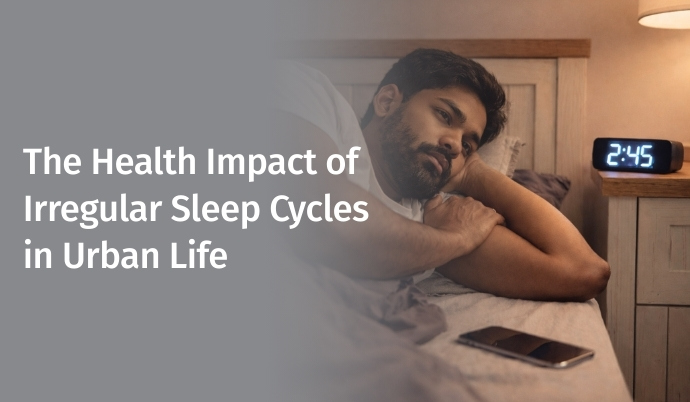
Today, sleep is often viewed as a luxury, or worse, a waste of time. We wear our sleep deprivation like a badge of honor. Between late-night work calls, traffic jams, and "revenge bedtime procrastination" (staying up late to reclaim personal time), our biological clocks are constantly under attack.
However, sleep is not merely a "rest" period; it is an active physiological state where the body repairs DNA, clears neurotoxins, and regulates hormones. When we force our bodies into irregular sleep patterns, we aren't just tired; we are biologically dismantling our health. Recent data underscores this danger: according to the NIH, many adolescents, including 1 in 5 in Delhi already suffer from sleep deprivation, a condition showing high correlations with depression and cognitive issues like poor focus and memory.
Here is why your erratic schedule is a medical emergency waiting to happen.
Key Takeaways: Quick Summary
1. What Is "Social Jetlag" and Why Does It Matter?
The body has a Circadian Rhythm or an internal clock that runs on a 24-hour cycle. This clock determines when hormones are released and digested through light and darkness.
In cities, there is a common phenomenon referred to as "Social Jetlag". For example, if a person wakes up at 6 am Monday to Friday to go to work and then sleeps until 11 am on the weekend they may think they have "caught up" on sleep for the weekend, however, to the body, they are experiencing a change in time zones every week.
The reason behind this phenomenon is that when the body has to keep changing its time zone each week, it cannot establish a consistent Circadian Rhythm, which can lead to irregular sleeping patterns, chronic fatigue, digestive problems, and a low immune system. Because the body cannot adjust to when it is supposed to be producing melatonin (sleep) and cortisol (energy), it leaves people feeling energized during the night and tired during the day.
2. Can Irregular Sleep Lead to Obesity and Diabetes?
The correlation between your body weight and your sleep schedule is direct. A disruption in your normal sleep pattern disrupts the two hormones that control hunger: Ghrelin and Leptin. Ghrelin is the hormone that stimulates appetite, while Leptin sends the message to your brain that "you are full." When your body is on an irregular sleep schedule, Ghrelin levels increase, which may explain why you have cravings for sweets and foods high in carbohydrates when you get home from a late-night out.
3. Is Your Snoring Actually Sleep Apnea?
Obstructive Sleep Apnea (OSA) is a serious condition where the muscles in the throat relax excessively during sleep, causing a blockage in the airway. This causes the person to stop breathing for periods of 10–30 seconds, often many times per hour.
Who is at Risk?
While obesity is a major contributing risk factor for sleep apnea due to excess tissue around the neck, it is a myth that only overweight people suffer from it. Individuals with normal body weight can also develop sleep apnea. Factors such as sleep position (sleeping on your back) and airway anatomy (jaw structure or tonsil size) play a significant role.
Spotting Sleep Apnea Symptoms:
If you or your partner notice these signs, consult a specialist immediately. OSA is a major cause of sudden cardiac arrest and strokes in young urban adults.
4. How is Your Sleep Related to Mental Health?
The brain requires more energy than any other organ. The brain uses the deep sleep stage, or Rapid Eye Movement (REM), to process emotional information and consolidate memories. Irregular patterns of sleep lead to disrupted cycles and result in an increased chance of developing "emotional dysregulation." This leads to increased reactivity, irritability and a heightened level of anxiety.
5. Sleep Disorder Treatment: Retraining the Brain
If you are stuck in a cycle of insomnia or erratic sleep, pills are rarely the long-term answer. Modern sleep disorder treatment focuses on behavioral and physiological correction.
Consistency is the Cure
We cannot escape the demands of urban life, but we can protect our biology. Remember that quality outweighs duration. Sleeping for 8 hours means very little if that sleep is fragmented or lacks deep REM cycles.
To maintain the Three Pillars of Health Sleep (Duration, Quality, Regularity), aim to go to bed and wake up at the same time every single day—including weekends.
The Department of Sleep Medicine caters to the evaluation, diagnosis, and management of all sleep-related conditions. If you struggle with loud snoring, gasping for air, or persistent insomnia, do not ignore it. Sir Ganga Ram Hospital offers comprehensive sleep studies (Polysomnography) to diagnose and treat underlying disorders effectively.
Book an appointment with SGRH today.
Frequently Asked Questions (FAQs)
Q1: Is melatonin safe for daily use?
A: Melatonin is a hormone, not a sedative. It signals the body that it is time to sleep. While safe for short-term use (like jet lag), relying on it daily can disrupt your body's natural production. Always consult a doctor for long-term sleep disorder treatment.
Q2: Does "Blue Light" really affect sleep?
A: Yes. The blue light emitted by phones and laptops mimics sunlight. It tricks your brain into thinking it is daytime, suppressing the release of melatonin. Urban dwellers should use "Night Mode" or avoid screens 1 hour before bed.
Q3: Why do I wake up tired even after 8 hours of sleep?
A: Quantity does not equal quality. You may be suffering from sleep apnea symptoms or frequent micro-awakenings that prevent you from entering deep (restorative) sleep. Alcohol consumption before bed also fragments sleep quality.
Q4: What is the best temperature for sleep?
A: Your body temperature needs to drop to initiate sleep. A cool room, ideally between 18°C to 22°C (65°F - 72°F), is best for high-quality rest.
Q5: Can exercise help fix irregular sleep patterns symptoms?
A: Yes, but timing matters. Morning or afternoon exercise deepens sleep. However, high-intensity workouts late at night can raise cortisol and body temperature, making it harder to fall asleep.