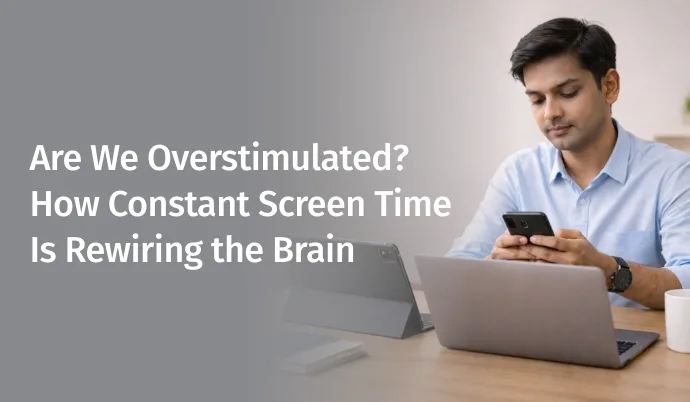
It starts the moment you wake up. The alarm rings, and before your feet touch the floor, you’ve checked three notifications, skimmed a headline, and scrolled a reel. By the time you pour your coffee, your brain has processed more data than a 19th-century human would encounter in a week.
We are living in an era of unprecedented connectivity, but it comes at a neurological cost. According to the NIH's largest-ever brain study, spending over seven hours a day on screens is linked to premature thinning of the brain cortex, the vital outer layer responsible for logic, planning, and focus.
We aren't just "distracted"; we are fundamentally altering how our neural pathways fire. This is "Popcorn Brain", a state where the mind is so used to the constant popping of digital stimuli that it struggles to settle on the slow pace of real life. But is this damage permanent? The blog breaks down the science of overstimulation.
Key Takeaways: Quick Summary
1. The Science: How Screens Hijack Your Reward System
To understand why we can't put the phone down, we must understand the brain's chemical currency: Dopamine.
Dopamine governs pleasure and motivation. Historically, our brains released it for survival activities, finding food or solving problems which required effort.
The Digital "Super-Stimuli"
Modern apps are engineered to be "super-stimuli." Every "like" or auto-playing video provides a micro-dose of dopamine. Unlike real-world rewards, digital rewards are instant and effortless.
Over time, this creates a dopamine deficit state. Your brain adapts by reducing dopamine receptors. The result? Real life like reading a book or sitting in silence feels painfully dull because it cannot generate the same chemical "high" as your screen.
2. Symptoms of Digital Overstimulation
How do you know if your brain is saturated? Digital overstimulation symptoms are often mistaken for stress. If you recognize these signs, your habits may be impacting your neurology:
3. Is Screen Time Shrinking the Brain?
The concern regarding excessive screen time mental health isn't just theoretical; it is visible on MRI scans. Neuroplasticity works both ways—it can wire for growth or atrophy.
Gray Matter Atrophy
Study's show that screen addiction can cause less gray matter in the brain's frontal lobe. This part of the brain is the CEO, in charge of impulsiveness and empathy. When the frontal lobe is weak, we become more emotionally and impulsively reactive
Compromised White Matter
Excessive usage is also linked to reduced integrity in white matter—the communication cables that connect the different regions of the brain. When these cables are more frayed, the processing speed is reduced, and the ability to control one's emotions is more difficult.
4. Anxiety & The Comparison Trap
Excess screen usage and mental health troubles are well-known, especially when it comes to anxiety.
5. Why You Never Feel Rested
You can not mention impacts of screen time for brain health unless you talk about sleeping too. This connection is damaging.
6. A Reset Protocol
The aim is not to get rid of technology, but it is rather to get skilled with it. Here you have a plan for neurological reset:
Be the Architect of Your Mind
The question "Are we overstimulated?" has a clear answer: Yes. But the situation is not hopeless. The brain is incredibly resilient. Studies show that even a short "dopamine fast", reducing screen time for 24-48 hours can begin to reset receptor sensitivity.
Your attention is your most valuable resource. Don't let an algorithm spend it for you.
If digital dependency is impacting your daily functioning, consult the Department of Psychiatry & Clinical Psychology at Sir Ganga Ram Hospital.
Book an appointment with SGRH today.
Frequently Asked Questions (FAQs)
Q1: Can screen time cause permanent brain damage?
A: "Damage" is strong, but it causes structural changes. However, due to neuroplasticity, many changes are reversible if habits are corrected early.
Q2: How much screen time is "excessive" for an adult?
A: While there is no magic number, non-work screen time exceeding 2-3 hours daily is linked to higher rates of anxiety and depression.
Q3: Does "night mode" make late-night scrolling safe?
A: No. It reduces eye strain, but the mental stimulation (reading a stressful email or watching a reel) still keeps your brain awake.
Q4: I feel anxious without my phone. Is this normal?
A: It is common, but not healthy. This is "Nomophobia" (No Mobile Phone Phobia), a clear sign of digital dependency.
Q5: Can meditation help?
A: Yes. Meditation is the antithesis of scrolling. It trains the brain to focus on one thing (breath) and accept boredom, strengthening the neural pathways that screen time weakens.