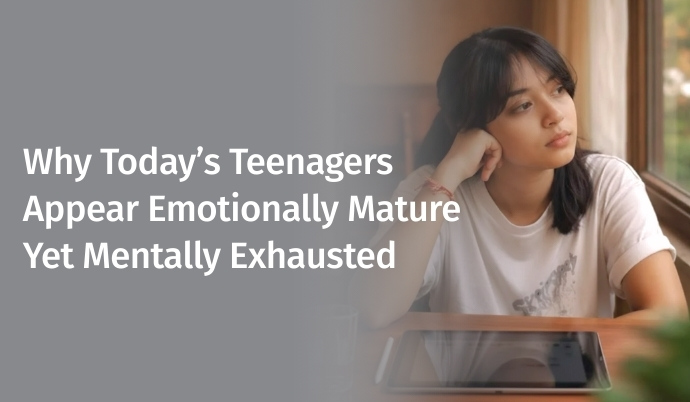
If you talk to a teenager today, you might be surprised by their vocabulary. They speak fluently about "boundaries," "gaslighting," "toxic traits," and "trauma responses." They seem self-aware, empathetic, and remarkably mature for their age. Yet, beneath this articulate surface lies a startling reality: they are tired.
This isn't just a feeling; it is a documented crisis. According to the NCRB, student suicides in India have surged by a shocking 65% between 2013 and 2023, a rate that drastically outpaces the overall increase in suicide deaths across the country.
In India, clinical psychologists are witnessing this surge firsthand, with adolescents seeking help not just for exam anxiety, but for a profound sense of existential dread and burnout.
This blog breaks down why today's teens are growing up fast but burning out faster.
Key Takeaways: Quick Summary
What Causes This "Maturity-Exhaustion" Gap?
To understand why teens feel this way, we must look at the root causes driving this specific type of burnout. It is not just about hormones; it is structural.
1. Overwhelming Amount of Information (The Responsibility of Understanding)
Today's teenagers are exposed to more information than ever before, almost all of which is available to them on multiple platforms around the clock.
2. The Performance of Wellness
As a result of social media, mental health has become another form of content. While de-stigmatizing therapy, it also creates an additional pressure for teens to "perform" wellness.
3. Academic and Economic Pressure
As competition increases and the economy is more uncertain, securing a future appears more difficult than ever. Because of this pressure, many young adults (including teens) feel as though they cannot afford to make mistakes while in middle school as a result of wanting to create an extraordinary resume.
4. Hyper-Comparison Culture
Teens are no longer comparing themselves to a small peer group.They are comparing themselves to the most attractive, successful, productive, and emotionally articulate people on the internet. This creates a distorted baseline for what “normal” looks like. Everyone else appears to be doing better, coping better, achieving more, and handling life with ease. The brain responds to this constant comparison as a threat, activating chronic stress and self-surveillance. Even emotionally intelligent teens begin to feel like they are always behind.
5. The Collapse of Unstructured Time
Teen brains need boredom, play, and mind-wandering for emotional integration. Instead, their days are filled with structured productivity or digital stimulation. Without quiet, unpressured time, the nervous system never fully resets. Emotions accumulate without being metabolised, leading to irritability, numbness, and burnout.
6. Perfectionism Disguised as Self-Awareness
Many teens appear self-reflective, but underneath it is a fear of getting things wrong. They are constantly monitoring: Am I reacting correctly? Am I being healthy? Am I toxic? Am I setting boundaries right? This turns emotional life into a test they feel they must pass, instead of something they get to live.
7. Social Lives Without True Safety
Teens are socially connected, but not always emotionally safe. Group chats, screenshots, cancel culture, and online gossip mean every interaction carries the risk of exposure. This creates relational hyper-alertness, they are always guarding how they come across. It is impossible to relax emotionally when you feel constantly watched.
1. Is High Emotional Intelligence a Double-Edged Sword?
We often tout the importance of emotional intelligence in daily life, and rightly so. High EQ allows for better relationships and empathy. Today's teens have this in abundance. They are excellent at labeling their emotions ("I feel anxious right now") and identifying the emotions of others.
Nonetheless, cognitive empathy (understanding how others feel) is not synonymous with emotional regulation (how one copes with feeling). Teens know how to talk like therapists, yet their emotional processing systems are still developing.
2. What Are the Hidden Signs of Mental Exhaustion?
It is easy to mistake burnout for laziness or typical teenage rebellion. However, mental exhaustion symptoms are distinct and physiological. Unlike normal tiredness, which is cured by sleep, mental exhaustion lingers even after rest.
Parents should pay attention to how their teen is feeling emotionally. A teen who has become mentally exhausted may not necessarily show sadness or other strong emotions. As a result of their mental exhaustion, teens can develop "decision fatigue”.
3. How Does Social Media Fuel Mental Burnout?
While it's clear that social media provides an escape from everyday life, it has also become a source of significant anxiety and stress. The way these platforms have been created allows for a constant proliferation of unrealistic lifestyles through an endless loop of visual content.
This "identity curation" requires massive cognitive effort. They are constantly managing their personal brand, counting likes, and navigating complex digital social hierarchies.
4. Why Is "Therapy Speak" Sometimes Harmful?
Teens have helped to reduce the stigma around mental health by talking openly about their struggles; however, using clinical language (therapy speak) in everyday conversations can lead to overdiagnosis. For example, when teens use terms like "abuse" and "depression" to define every disagreement or bad moment, they are making the common experiences of sadness and conflict sound like unnatural mental disorders.
5. Why Overthinking Has Replaced Emotional Processing
Teens today are highly self-aware, but awareness without containment leads to overthinking. Instead of feeling an emotion and letting it pass, they interrogate it:
Why do I feel this? What does it say about me? Is this trauma? Is this anxiety? Should I be worried?
This constant internal questioning keeps the brain in analytical mode rather than emotional mode. True emotional processing happens when feelings are experienced in the body and allowed to move through. Overthinking traps emotions in the mind, where they loop instead of resolve.
As a result, teens may appear reflective and articulate, but inside they feel stuck, restless, and mentally tired.
6. How High Sensitivity Becomes Emotional Overload
Many of today’s teens are deeply sensitive, to tone, rejection, injustice, and social dynamics. Sensitivity itself is not a weakness; it is a form of emotional intelligence. But without strong emotional boundaries and nervous system regulation, sensitivity turns into overstimulation. Teens absorb everyone’s moods, micro-expressions, and online reactions. They feel responsible for how others feel.
This creates chronic emotional labour, constantly adjusting, caretaking, and self-monitoring, which leaves very little energy for simply being themselves.
7. The Pressure to Be Self-Aware at All Times
Modern teens are expected to be emotionally evolved: They must be self-reflective, accountable, communicative, and emotionally responsible, all while navigating school, friendships, identity, and social comparison.
This creates a form of emotional performance. Instead of being messy, confused, or reactive (which is developmentally normal), teens feel pressure to be emotionally correct.
But emotions are not meant to be performed. They are meant to be felt, expressed, and metabolised. When teens try to manage their feelings “properly” all the time, it adds another layer of exhaustion.
8. Why Rest No Longer Feels Restful
Even during downtime, teens remain psychologically active. They are scrolling, comparing, responding, checking, and reacting.
Their bodies may be lying on the bed, but their nervous systems are still working.
True rest requires nervous system safety, moments where the brain does not have to monitor, perform, or evaluate. Without this, exhaustion accumulates no matter how many hours they sleep.
What Teens Actually Need Instead
Teens do not need more emotional language. They need more emotional containment.
They need adults who can:
Emotional maturity is not about how well you can explain your feelings. It is about how safely you can live inside them.
How Can Parents Help?
Reclaiming Childhood
While the maturity of teens today shows their adaptability, the price they pay for this perfection is high. However, as adults and parents, if we identify the signs of mental fatigue early and create environments where teens do not feel pressured to always be "on," through sound and supportive parenting, we can support our teens in finding balance between their sophisticated emotional understanding of the world and their need to rest and recuperate. The Department of Psychiatry & Clinical Psychology at Sir Ganga Ram Hospital offers specialized adolescent counseling and stress management programs designed to help young minds thrive, not just survive.
Book an appointment with SGRH today.
Frequently Asked Questions (FAQs)
Q1: What is the difference between stress and burnout?
Stress is characterized by the feeling of having too much going on, and having to deal with this excess; whereas Burnout is the perception of not having enough energy, motivation, or concern.
Q2: How can I improve my teen's emotional intelligence without the exhaustion?
In order to enhance your teenager’s Emotional Intelligence without added stress, encourage them to find ways to express their feelings.
Q3: Are "mental burnout symptoms" permanent?
Burnout is a reversible condition; with an appropriate amount of sleep, decreased cognitive load (i.e. limited commitment to social media, texting, and the like), and proper nutrition the brain will recover from Burnout.
Q4: Should I take my teen's phone away to stop the exhaustion?
Taking away your teenager’s phone to avoid causing them to be burnt out will likely create a greater amount of stress due to the loss of their social networks.
Q5: Why does it look like teens are lazy when they really aren’t?
Mental exhaustion causes the brain to be overwhelmed and respond with a “freeze response.”