The Pride of Staying "Busy"
"How are you?" "Busy. Tired."
This exchange has become the default greeting of the 21st century. We live in a culture that glorifies the grind, where skipping lunch is seen as dedication and replying to emails at midnight is a badge of honor. But this relentless pursuit of productivity is exacting a heavy price. According to The Times of India, high work-related stress was identified as a key contributor to cardiac events in over 2,000 heart patients.
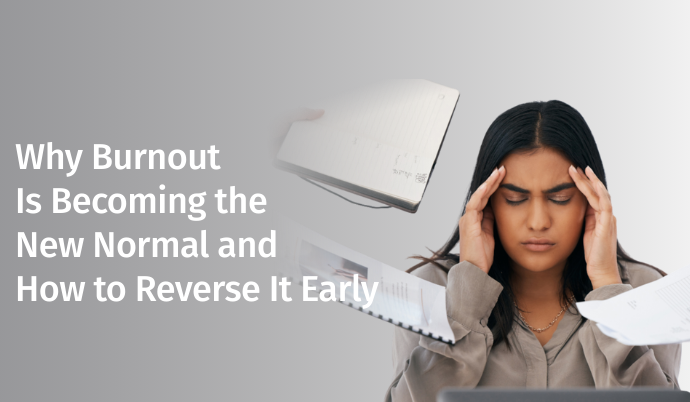
Burnout is no longer reserved for high-powered CEOs; it has become the "New Normal" for students, parents, and employees alike, functioning as a silent epidemic that hollows people out from the inside.
But here is the critical medical distinction: Burnout is not the same as having a bad week. It is a state of vital exhaustion where your battery doesn't just need recharging, it is no longer holding a charge at all. This blog breaks down the science of why we are burning out and how to pull back from the edge.
Key Takeaways: Quick Summary
Causes of Burnout
Burnout is rarely a personal failure; it is almost always a structural one. Psychologists identify six primary triggers. The most obvious is
1. Difference between Chronic Stress & Burnout
To treat the problem, you must name it correctly. Many people confuse chronic stress and burnout, but they are distinct biological states.
Stress occurs when you are overwhelmed with many things to do, excessively motivated by the idea that by taking charge you can ease your stress. Conversely, Burnout occurs when you lose interest in everything and no longer feel emotionally connected to your life. Stress is like a raging fire that is burning away everything in its path, and the effect of burnout is similar to a burned-out house—the fire is out, but nothing remains.
2. Decoding Burnout Symptoms and Causes
Burnout can gradually build over time and destroy resilience. If you're able to recognise the symptoms of burnout and what caused it early on, you will have the best chance of defending against it. The World Health Organisation has identified three dimensions that define burnout.
Burnout is the slow destruction of your ability to cope, or "resilience", and is defined by WHO in a three-dimensional way. Exhaustion is the first dimension. It's the deepest form of fatigue; simple tasks become as difficult as climbing Mount Everest. Cynicism comes next, which is the emotional defence mechanism of disconnecting from others. The third dimension is Inefficacy; it creates a feeling of uselessness at work no matter how hard you try, causing symptoms of "imposter syndrome".
3. How Does Burnout Affect Your Body?
Chronic burnout occurs when the "Fight or Flight" system remains permanently activated (i.e., it cannot return to a resting state). This is not simply a thought process; it is a physical condition. Continual unmanaged/stressful experiences create excessive amounts of cortisol in the body, which makes the Prefrontal Cortex (associated with attention/focus) shrink and enlarges the Amygdala (associated with fear). The result is that you are more anxious, more reactive to external stimuli, and less able to prevent illness because your immune system is suppressed.
4. How to Prevent Burnout?
Burnout is often thought to be cured by taking time off from work. Although taking a break from your routine often allows for much-needed recovery, it doesn't solve the underlying problem. Therefore, recovery from burnout requires that you change how you handle stress on a structural level.
Conclusion
Burnout is your body's violent scream saying, "I refuse to continue living this way." Listen to it. Reversing burnout isn't about doing more self-care; it is often about doing less. It is about recognizing that you are a human being, not a human doing.
If you feel yourself slipping into the dark water of cynicism, the Department of Psychiatry & Clinical Psychology at Sir Ganga Ram Hospital is equipped to help you navigate this journey with medical support and therapy.
Book an appointment with SGRH today.
Frequently Asked Questions (FAQs)
Q1: Can burnout cause physical pain?
A: Yes. Chronic muscle tension from stress often manifests as back pain, neck stiffness, and tension headaches. Many patients also experience gastrointestinal issues like IBS.
Q2: How long does it take to recover from burnout?
A: It varies. Mild cases may take a few weeks of rest and boundary setting. Severe burnout, where brain biology has been impacted, can take months or even a year of active therapy and lifestyle change.
Q3: Is burnout the same as depression?
A: They are different. Burnout is context-specific (usually work-related); if you remove the stressor, you feel better. Depression is pervasive and follows you into every aspect of life, even when work is going well.
Q4: Can I fix burnout without quitting my job?
A: Often, yes. By renegotiating deadlines, delegating tasks, and strictly enforcing work-life boundaries, many people recover in their current roles. However, if the workplace culture is toxic, leaving might be the only cure.
Q5. Does working from home (WFH) increase the risk of burnout?
A: Surprisingly, yes. While WFH saves commute time, it often blurs the boundary between "home" and "office." This leads to the "Always On" phenomenon, where employees feel pressured to be available 24/7. Without a clear physical separation (like leaving an office building), the brain struggles to switch off, accelerating burnout.